
Large language models (LLMs) don’t have a stable way of knowing what’s true in your domain. Without access to reliable external context, they have to “guess,” which can lead to hallucinations. Retrieval-augmented generation (RAG) helps ground LLMs by supplying relevant information at inference time. Two common approaches are vector RAG and an LLM knowledge graph.
This guide helps you decide which architecture fits your business needs.
What is a knowledge graph and how does it ground an LLM?
An LLM knowledge graph provides a structured connection between different pieces of information. Nodes represent entities while edges represent relationships. For example, a knowledge graph can help a retail model define which customers purchased what products at a store.
Knowledge graphs typically represent facts as triples: a subject, predicate, and object.
For example, in the statement “Customer A owns Product B”:
- The subject is “Customer A.”
- The predicate is “owns.”
- The object is “Product B.”
An LLM can retrieve these structured facts as context. This grounds its response in information from your knowledge base so it doesn’t need to hallucinate or rely solely on its pretrained knowledge.
Entities, relationships, and semantics
Think of entities like the nouns of your data and relationships as the verbs that connect them. A knowledge graph’s semantics help the LLM understand how those pieces of information interact.
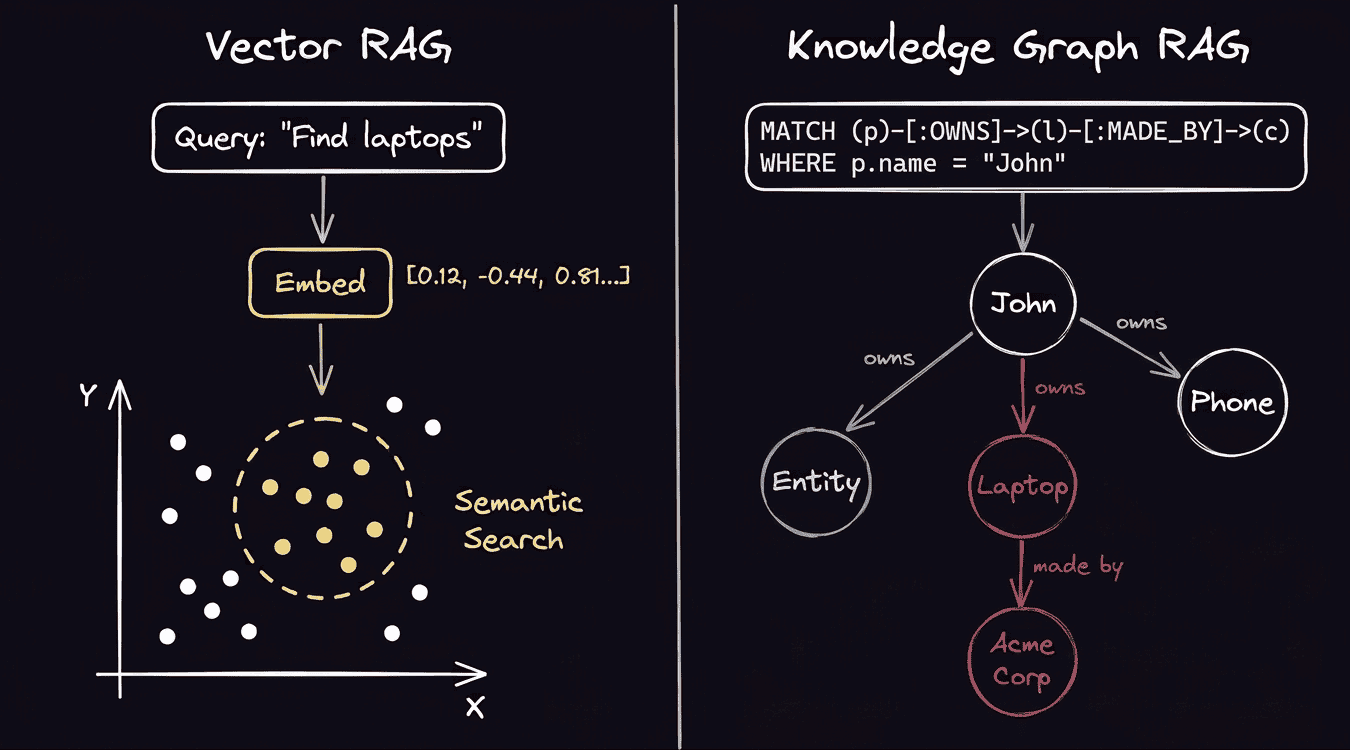
A knowledge graph-based RAG (often called GraphRAG) can use entity extraction and graph traversal to connect information across multiple sources. This allows the LLM to use multi-hop retrieval or reasoning when it needs to understand several relationships to answer a question.
Why grounding reduces hallucinations
Grounding gives an LLM stable access to external information that you designate as authoritative. If the model has a larger knowledge base to access, it’s less likely to hallucinate. But its responses are only as accurate as the underlying data. You need to validate the retrieval process and graph construction if you want the model’s responses to be reliable.
Knowledge graphs vs. vector RAG
Standard vector RAG pulls together text chunks that are semantically similar to a user’s natural language query. It works well when the information the model needs to answer a question is contained in just a few relevant passages. But if the model needs to connect information across several documents, it may need extra retrieval or reasoning mechanisms.
A knowledge graph-based RAG system explicitly represents entities and their relationships. Graph traversal can retrieve connected facts across sources and support multi-hop questions. Users can inspect graph paths in these systems, which provides useful traceability, especially in highly regulated industries like healthcare and law.
The decision framework
If a model only needs to answer questions based on information in a paragraph or smaller number of semantically related passages, vector RAG can work. Users often find it’s easier to build and maintain than a knowledge graph.
But if you need a model to answer complex questions with information across multiple sources or documents, a knowledge graph may be useful. It supports multi-hop reasoning so the model can take full advantage of your knowledge base.
Knowledge graphs can also reduce the amount of irrelevant context passed along to an LLM. This allows the model to use tokens efficiently, but the overall costs associated with knowledge graph creation and maintenance are often greater than those associated with standard vector RAG.
How LLMs build a knowledge graph from unstructured text
Knowledge graph construction varies depending on whether your team uses a predefined schema or allows the structure to evolve more dynamically.
Entity and relationship extraction (triples)
Traditional knowledge graph construction often requires hard-coded extraction rules or specialized ML models. Conversational LLMs have made it easier to automate the pipeline that turns raw text into a network of facts.
An LLM knowledge graph builder scans the segments for subject-predicate-object triples. It then saves these structured relationships in a graph. This process converts loose sentences into a formal list of verifiable facts. Models can then use defined paths to perform multi-hop reasoning for complex uses, such as fraud detection, recommendation systems, and biomedical scientific discovery.
Entity resolution and schema
Entity resolution and schema reduces clutter and inaccuracies in your data by combining duplicates. For example, the model recognizes that the “United States of America” and the “U.S.” are the same country in a list of addresses.
Without entity resolution, data quality declines due to fragmentation and duplication. This is a crucial process, but it can’t be completely automated or unsupervised. LLMs need canonicalization and validation when deduping entities to avoid errors.
Schema-based vs. schema-free construction
You should select your schema construction based on your domain, data quality, and query predictability.
A schema-based construction predefines the information a graph uses. This improves consistency and makes the resulting data easier to validate and query.
A schema-free method prioritizes discovery and allows the model to make new connections between entities. This flexibility can be useful for models that need to perform exploratory research or navigate a rapidly changing domain, such as product or R&D intelligence. But it can also introduce greater inconsistency and validation requirements.
Building knowledge graph and vector RAG workflows in n8n
n8n is a source-available, AI-native automation platform that engineering teams can use to create and maintain production RAG. You get visibility into both data ingestion phase and the individual retrieval and processing steps, which can make systems easier to debug and maintain.
Vector RAG with the built-in vector store nodes
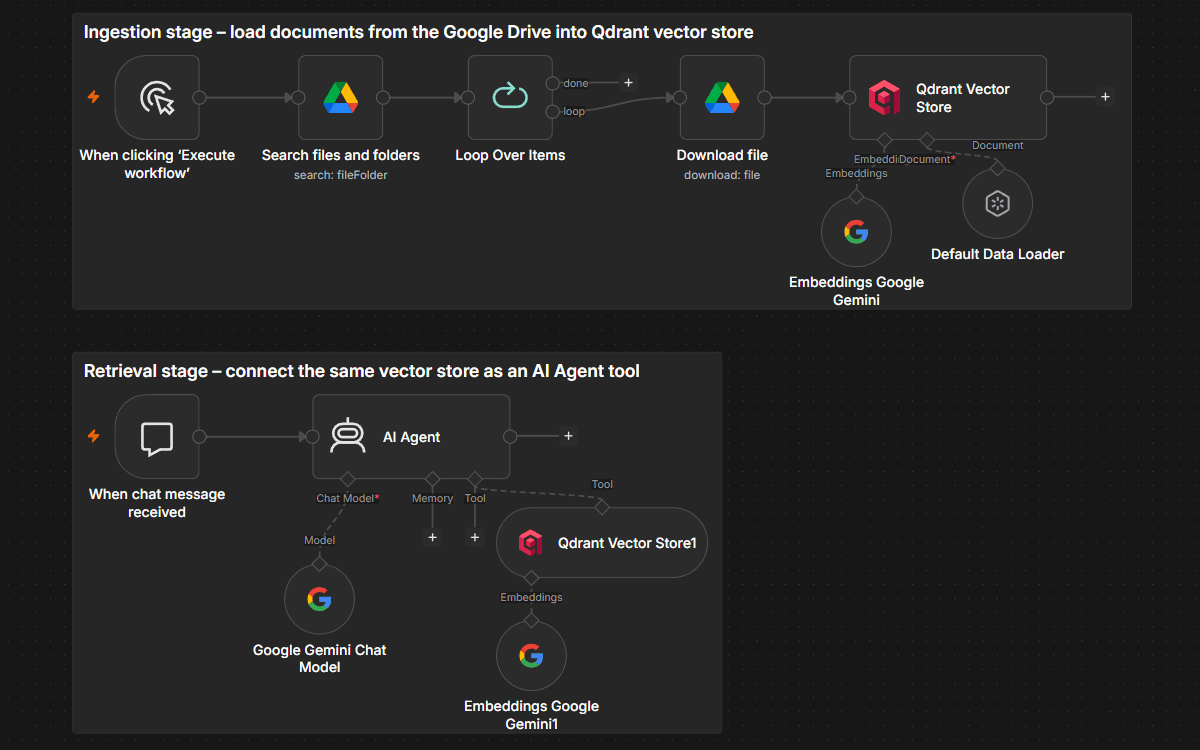
n8n supports vector-store integrations via specialized nodes, including Pinecone, Qdrant, and Supabase. The Default Data Loader coordinates chunking, while a connected embedding model node, such as Embeddings OpenAI or Embeddings Google Gemini, generates the vectors for storage. When you need to pull semantically similar text directly into your workflow, use the Vector Store Retriever node.
Extracting entities to a graph database
An LLM can extract entities and relationships from document chunks in a knowledge graph workflow. n8n can then send the resulting structured data to a graph database using the HTTP Request node or by calling sub-workflows as tools.
Combining both (HybridRAG) with the AI Agent node
The AI Agent node can support a HybridRAG approach to your system. It orchestrates multiple retrieval tools, allowing a workflow to use vector search for semantic retrieval and graph-based retrieval for relationship-based queries.
Debugging and monitoring your RAG pipeline
Use execution logs and step-level debugging to get full visibility into every node’s data. If you have logic errors and need to re-run executions, simply load the failed production data back into the editor.
Choosing the right grounding for your AI model
The decision to use vector RAG or an LLM knowledge graph depends on the structure of the information your model needs to retrieve.
- Use standard vector RAG when you want a simple, cost-effective architecture to find information in a small number of semantically related documents.
- Use a knowledge graph when the model needs to understand explicit relationships between entities to retrieve information for complex queries.
- Consider HybridRAG when your workflow needs both semantic document retrieval and relationship-based retrieval capabilities.
And if you use n8n, you don’t need to feel locked in to one retrieval model. You can start with vector RAG, then easily add graph-based retrieval later if your use case changes. If you want to experiment with the right architecture for your system: