



Choosing the right model is just one part of building a successful retrieval-augmented generation (RAG) pipeline. Сhunking also plays a big role. The way you divide your documents affects what gets retrieved, how much context your LLM receives, and how accurate its responses are. That's why chunking is best treated as a design decision, instead of just a preprocessing step. There are various types of chunking, and semantic chunking is one of them.
In this article we’ll help you understand the trade-offs so you can pick the right chunking approach for your data.
What’s semantic chunking?
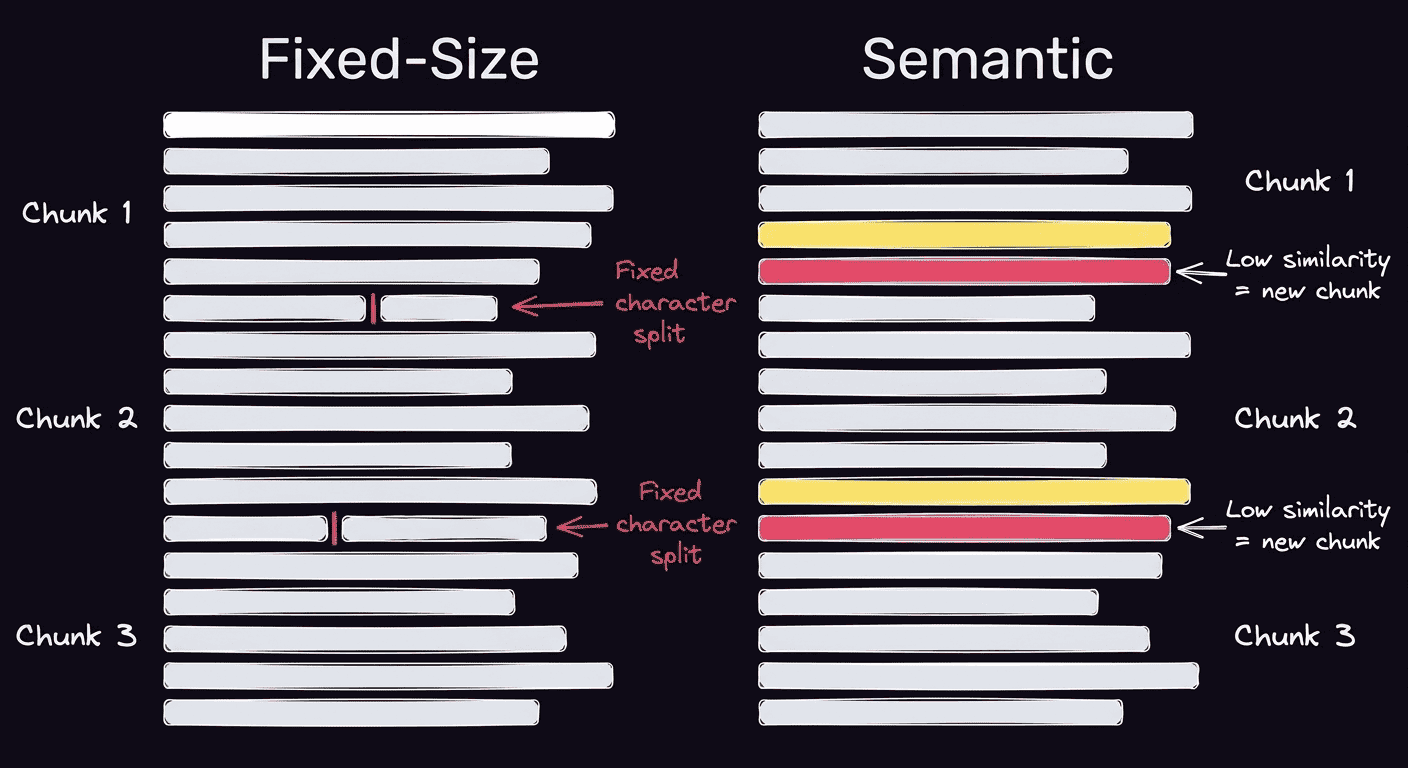
The easiest method to prepare a document for RAG is to split the content based on a fixed number of tokens or characters. This approach is fast, but it doesn't always respect the structure of the content. A paragraph, section, or even a sentence can end up split in two.
In RAG systems, semantic chunking is a type of data chunking that groups text by meaning instead of size. A semantic chunker applies this logic automatically, identifying natural topic boundaries instead of relying on fixed token or character limits.
Chunk sizes naturally vary. A glossary entry might only need a sentence or two, while a section explaining an authentication flow is usually better kept together. What matters is that the boundaries follow the content instead of an arbitrary limit.
Why does a chunking strategy matter for RAG?
Imagine someone searching your docs for rate limits. If the limits are stored in one chunk and the exceptions in another, your retriever may only surface half the answer.
Finding the right balance is what makes chunking so important. Larger chunks preserve more context but can reduce retrieval precision and increase token usage. Smaller chunks are more targeted, but they can separate ideas that belong together and leave the model without the context it needs to generate an accurate response.
That's why you shouldn’t think of chunking as a one-size-fits-all decision. The best approach depends on your content and the trade-offs you're willing to make. A product manual, a company’s annual meeting report , and legal contract all have different structures, so they often benefit from different chunking strategies.
Chunking methods
There's no shortage of ways to approach text chunking, and most production RAG systems don't rely on just one method. The right strategy depends on the structure of your content, the quality of retrieval you need, and how much complexity you're willing to manage.
The methods below cover the most common approaches, along with the trade-offs to consider when choosing between them.
Fixed-size chunking
Fixed-size chunking splits text after a set number of tokens or characters, regardless of where sentences or topics begin and end. It's predictable, easy to implement, and often the fastest way to build a retrieval pipeline. The downside is that meaningful context can be split across chunks, making it harder for your retriever to return complete answers. If you're indexing consistent, well-structured content, fixed-size chunking is a solid baseline.
Recursive character splitting
Recursive character splitting tries to preserve the structure of a document before it falls back to smaller units. Rather than cutting text at an exact length, it looks for natural breakpoints like headings, paragraphs, or sentences. This method produces cleaner chunk boundaries without adding much complexity, making it a practical choice for many production RAG systems.
Structure-aware splitting
Some documents already tell you where chunks should begin and end. API documentation, Markdown files, knowledge bases, and technical manuals all contain headings and sections that reflect the way people consume information. Structure-aware splitting preserves those boundaries, keeping related content together and helping retrieved chunks make more sense on their own.
Embedding-based semantic chunking
Instead of relying on formatting, embedding-based semantic chunking uses vector similarity to detect shifts in meaning. When the content moves from one topic to another, the system begins a new chunk. This often produces higher-quality retrieval, especially for unstructured text, but it also requires additional processing during indexing. The extra effort can be worthwhile when retrieval quality matters more than indexing speed.
Contextual chunking
Contextual chunking — also known as context-aware chunking — goes a step further by considering the surrounding context that helps a chunk make sense after retrieval. Instead of focusing only on topic boundaries, it maintains relationships between neighboring sections when that extra context improves search results. The extra context can improve retrieval for complex documents, though it also increases indexing complexity and isn't necessary for every RAG pipeline.
4 best practices for implementing semantic chunking
No single chunking strategy works well in every situation. Once you choose an approach, the following implementation decisions can influence retrieval quality as much as the chunking method itself.
Match your chunking strategy to your content
The best chunking strategy depends on what you're indexing. Technical documentation often benefits from structure-aware splitting. Research papers or long-form articles may require semantic boundaries to preserve context. Start by looking at how your documents are organized before choosing a strategy.
Don’t optimize for chunk size alone
It's tempting to chase an ideal chunk length. There’s just one problem: No universal chunk length exists. Instead, focus on whether each chunk contains enough context to answer a question on its own. If important information is consistently split across chunks, that's usually a sign the boundaries need adjusting.
Measure retrieval performance, not just indexing speed
The only way to know if a chunking strategy works is to test it. Compare retrieval results across representative queries, look for missed context or irrelevant matches, and evaluate how those differences affect downstream responses. Small changes to chunk boundaries can have a surprisingly big impact on answer quality.
Build chunking into your workflow
Chunking isn't a one-time preprocessing step. As your documents, embedding models, or retrieval requirements change, your chunking strategy needs to evolve as well. n8n is a source-available AI-native automation platform that helps teams do this without programming.
It gives non-technical users a visual canvas to test and refine chunking strategies, while technical teams can plug in more advanced logic when needed. You can route different document types through specific text splitters and inspect execution history to refine your approach over time.
Practical example: Implementing semantic chunking with n8n
Say you're building a RAG chatbot for your company's documentation. Instead of sending every document through the same pipeline, you could build a workflow in n8n that:
- Loads content from Google Drive, a database, or another document source
- Routes Markdown docs through the Recursive Character Text Splitter configured for Markdown headers, while using a broader recursive split for long-form guides.
- Generates embeddings for each chunk and stores them in your vector database
- Records every execution so you can inspect the output and refine your chunking strategy over time
Because the workflow is modular, you can update one part of the pipeline without redesigning the rest as your content or retrieval requirements evolve.
Building better RAG pipelines with semantic chunking
Semantic chunking promises improved quality of the answers your users receive. However, the right chunking approach depends on the documents you're indexing and the problems you're trying to solve. Treat chunking as part of your retrieval architecture from the project start.
Instead of chasing the most advanced technique, start with the simplest strategy that meets your needs. Evaluate it against real queries, pay attention to the quality of the retrieved context, and refine your approach as your corpus or requirements change. Iteration will usually have a bigger impact than blindly adopting a more complex algorithm.
n8n gives you a place to build, test, and run chunking pipelines in production. With configurable text splitters, embedding model and vector store integrations, and execution history for debugging, you can experiment with different chunking strategies and refine them as your retrieval needs evolve.
FAQ
What’s a semantic chunker?
A semantic chunker is a tool or algorithm that splits text into chunks based on meaning instead of a fixed number of tokens or characters. Semantic chunkers use different techniques, including embeddings, topic modeling, document structure, to detect where one idea ends and the next begins.
How is semantic chunking different from text chunking?
Text chunking is the general process of dividing documents into smaller pieces for indexing or retrieval. Semantic chunking is a strategy that creates chunks based on meaning. Instead of splitting consecutive sentences at arbitrary boundaries, it aims to keep related information together: sentences with high similarity scores remain within one chunk. If the similarity scores fall below a certain threshold, a new section begins automatically.
Does semantic chunking always improve RAG performance?
Not necessarily. Semantic chunking often improves retrieval quality for unstructured documents, but it also increases indexing complexity. For structured content like API documentation or product manuals, simpler approaches like recursive or structure-aware splitting may produce comparable results with less overhead.
What makes a good chunk?
A good chunk can stand on its own when retrieved. It contains enough context to answer a question without including large amounts of unrelated information. In practice, that means preserving meaning while keeping the chunk focused on a single topic or task.