
Engineering teams choosing enterprise API management and integration platforms can struggle, often getting more than they need or missing out on key capabilities.
These solutions solve different problems, and only few provide the execution control, self-hosting, and code-level extensibility teams need. This guide is for teams comparing iPaaS versus API management who hit that limit and are seeking alternatives.
The difference between API and integration platforms: What they solve
iPaaS and API management aren’t direct competitors. They solve different types of problems, so organizations often deploy both platforms for a more comprehensive enterprise architecture.
What’s iPaaS, and what does it solve?
An iPaaS (Integration Platform as a Service) is usually a cloud-based tool for connecting applications and data sources. It allows teams to build automated business processes and integrate APIs. Modern companies need these connections: The average enterprise has around one thousand apps but integrates only 27% of them.
Engineering teams use iPaaS to:
- Connect cloud applications: Move and transform data between separate systems without the need for middleware.
- Drive process automation: Build workflows that trigger actions across multiple cloud and on-site systems.
- Synchronize data sources: Maintain consistent information across cloud-native and legacy systems by automating data workflows.
- Expand integration capabilities: Use prebuilt connectors to manage connectivity between hundreds of SaaS tools with low or no code.
What’s API management, and what does it solve?
This option governs API throughout its entire lifecycle, from design to retirement. It provides the governance and secure framework to expose data safely to internal developers or external partners.
Engineering teams use API management to:
- Secure endpoints: Protect sensitive cloud applications from unauthorized usage by enforcing access controls, authentication, and encryption.
- Centralize governance: Create one unified set of policies for governing API development, including versioning control and lifecycle management.
- Provide a developer portal: Offer a self-service portal for users to browse documentation, get access keys, and test existing APIs.
- Monitor analytics: Maintain system reliability by tracking metrics across microservices, including error rates and usage patterns.
- Control traffic flow: Use an API gateway to enforce rate limits and quotas, which prevents backend applications from getting overloaded by high-volume requests.
Where the two overlap, and where each one breaks down for engineering teams
API management and iPaaS give businesses the ability to manage connectivity and technical requirements, like access controls, performance analytics, and traffic regulation via an API gateway. They both handle endpoints but differ in architectural role and scope.
But looking only at these two options is limiting. Each causes developers to hit a technical ceiling.
iPaaS platforms often lack the rigorous governance, versioning control, and security posture from a dedicated API platform. Meanwhile, API management tools don’t natively handle the complex workflow logic, branching, or orchestration needed for process automation across data sources and microservices.
Additionally, both categories are cloud-based, which may fail to meet strict data residency needs. And neither platform is built for orchestration across multiple cloud applications at the same time.
How n8n covers the ground iPaaS and API management leave open
n8n is a source-available AI-native automation platform that’s a serious competitor to iPaaS solutions, and it offers a lightweight alternative to API management. It enforces execution control, self-hosting, and code-level extensibility directly within its workflows.
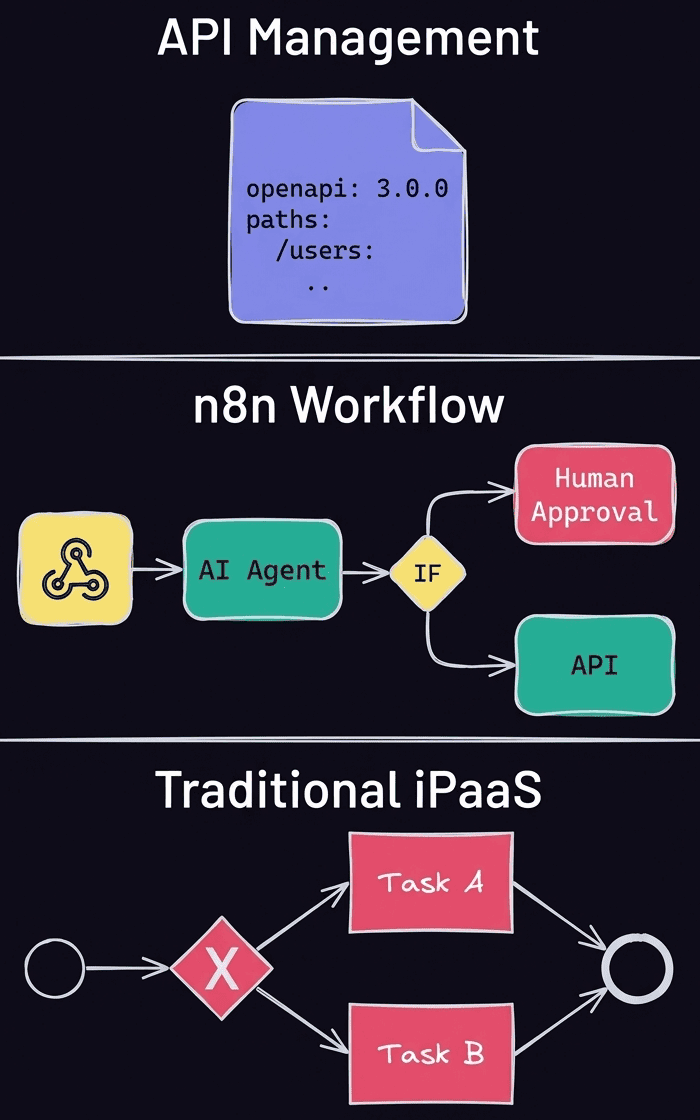
Instead of just defining governance policies, n8n manages the layer where process automation and API integration actually happen. This approach provides a secure framework through self-hosted deployment, which ensures sensitive credentials and workflows remain on your own infrastructure.
n8n gives technical teams the same level of control they could expect from hand-rolling integrations in custom code. They can achieve this without the abstraction tax of a closed, SaaS-based iPaaS platform or the governance overhead of a full API management platform.
Technical teams reach for n8n once they have outgrown what a lightweight iPaaS can do or have decided to avoid the bureaucracy that comes with dedicated API management.
To see if it’s the right fit for your enterprise, consider these capabilities:
- Self-hosting allows teams to keep data on their own infrastructure.
- Centralized credential stores simplify API integration by managing native auth types like API keys and Oath2.
- The Webhook and Respond to Webhook nodes trigger and control workflows, letting teams create callable API endpoints.
- The Executions View supports reliability through a detailed execution history.
- The HTTP Request node allows developers to query any endpoint with a REST interface. Several n8n features like Retry On Fail settings, the Stop and Error node, and Error workflows help manage transient failures in automation workflows.
- The Code node allows developers to use custom Python or JavaScript for any logic that exceeds standard node capabilities.
API and integration platform comparison: Which one does your team actually need?
There isn’t one perfect solution for every company, and some organizations use multiple tools at once. Focus on your team’s needs and the long-term architecture of your stack to build your stack.
When to choose iPaaS
Choose iPaaS as your solution when you need:
- Pure data movement between SaaS solutions: Primary objective is to move data between cloud applications without complex logic or custom workflows
- Rapid business process automation: When you need to quickly manage connectivity between hundreds of SaaS tools
When to choose API management
Choose API management when you need:
- Software for a governed API product: When you need to create APIs for a third-party that requires a developer portal, rigorous versioning control, and a secure API framework
- Traffic regulation and endpoint security: Companies that must enforce access controls, rate limiting, and traffic monitoring via an API gateway
When to combine iPaaS and API management
A combination of iPaaS and API management makes sense when you have mixed environments with complex integration needs. Most organizations may combine tools to simultaneously handle process automation, API development, and microservices monitoring.
When to choose n8n
Pick n8n when you need:
- AI agent orchestration across systems: For technical teams building AI agents that require code-level extensibility and automation
- Strict self-hosting or auditing requirements: For organizations in tightly regulated environments that must pass high-security audits
- Comprehensive integrations: Teams that need pre-built integrations and custom connectors
Build a future-proof integration foundation
iPaaS and API management work well together, providing a comprehensive solution. It isn’t a question of which one — many teams realize they need both.
If you’ve outgrown light iPaaS solutions but don’t need the overhead of an API management platform, n8n fills the gap. n8n connects apps, moves data, and automates processes like an iPaaS, with the option to self-host for compliance requirements.
n8n lets you build API-like endpoints and orchestrate calls to other APIs without a full management platform. And if your needs grow, you can put an API gateway in front of an n8n instance for tighter governance.