




State is the information an AI agent carries across tasks and, from conversation history to long-term memory and user profiles. Choosing between stateful versus stateless architecture shapes how agentic workflows manage scale and recover from failures. It’s a core design decision with implications for your entire system’s reliability and performance.
Stateful vs. stateless: The core concepts
The difference between stateful and stateless architecture comes down to what happens to information between interactions. Does the system retain what happened from earlier interactions, or does it start every request with a blank slate?
Before comparing stateful versus stateless applications, it helps to define three related terms:
- State: Information that persists beyond a single interaction, such as a shopping cart, authentication status, or conversation history.
- Session: A series of related interactions associated with the same user or process. It gives the system a boundary for deciding which interactions belong together.
- Context: The information the LLM-powered system uses to understand and respond to the current request. It can come from the current input, previous interactions, or stored data.
Stateful applications
A stateful application retains information from previous interactions and uses it to handle future ones. That information might include conversation history, authentication details, shopping cart contents, or progress through a multi-step process.
The advantage of statefulness is continuity. The application can pick up where an earlier interaction left off. The trade-off is that you need somewhere to store and manage that state and ensure it's available when the next request arrives.
Stateless applications
A stateless application treats each request independently. This means everything needed to process the request must arrive alongside it or be retrieved from another system. There’s no falling back on information retained from the previous request.
It’s easier to distribute requests across instances in stateless applications. Any suitable instance can handle the request because it doesn’t need to recover state elsewhere. This can make the application more scalable and fault-tolerant. But when continuity matters, you need to introduce state somewhere in the system. That's why many architectures use a stateless request-processing layer while storing persistent data in a cache or other shared system.
Key differences between stateful and stateless
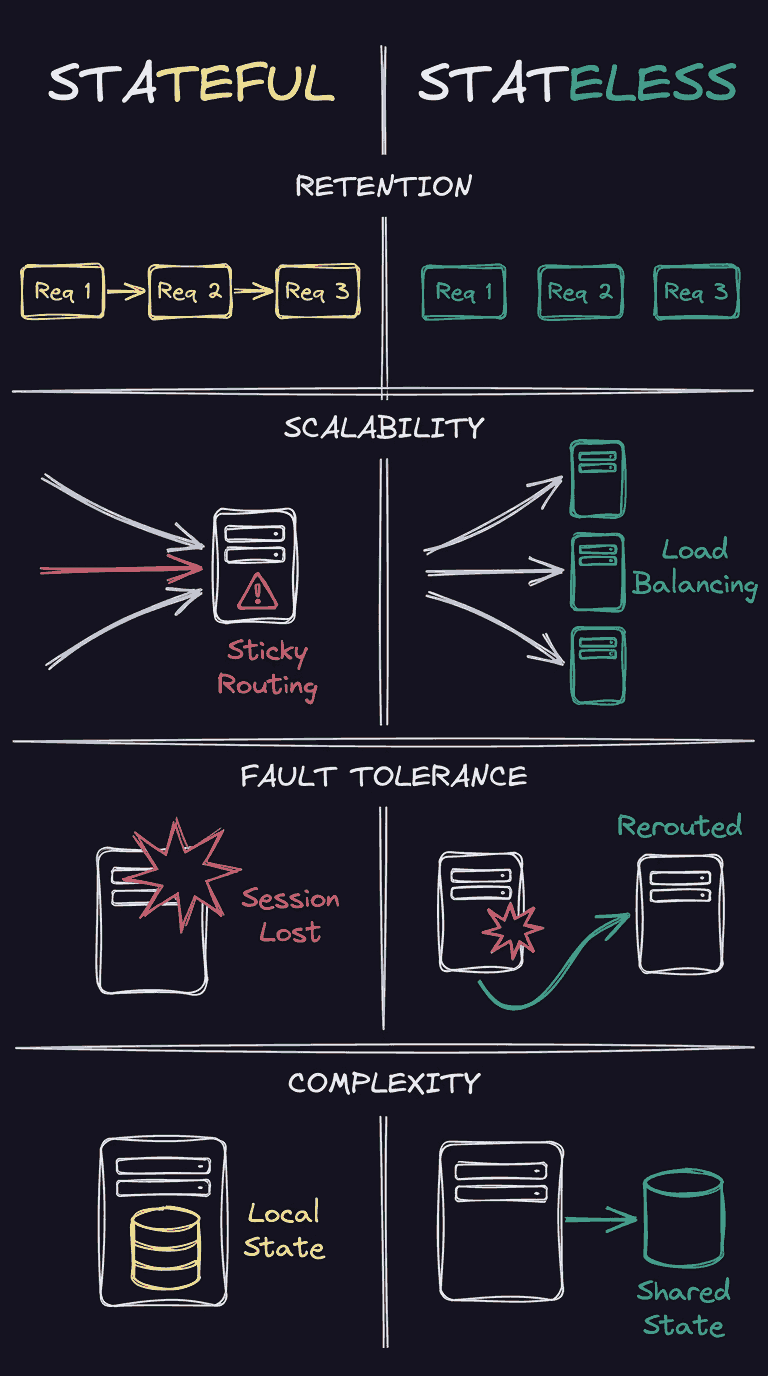
The practical differences in stateful versus stateless architecture start with where information lives. In a stateful system, the application retains information between requests. In a stateless system, each request contains or retrieves what it needs independently. That decision affects how the system scales, recovers from failures, and uses resources.
You don’t need to make an entire system stateful or stateless. Many architectures keep compute stateless for easier scaling while moving the state that needs to persist into a database, cache, or other shared store.
Are AI agents and LLMs stateful or stateless?
LLMs don’t automatically retain the conversation from one inference request to the next. If an application wants a model to use previous messages, they must be supplied in the model’s input or retrieved elsewhere in the system.
AI agents can behave statefully by giving the model access to information from earlier interactions. That’s how memory works — the agent stores and retrieves state outside the model, then adds relevant context to future requests.
How that state is stored depends on how long it needs to last and who needs access to it. An in-memory buffer can hold recent messages within a session, while a persistent store can preserve them beyond a single process or restart. In distributed systems, a shared store can make state available across multiple points.
When to use stateful vs. stateless APIs
Use stateless APIs for scale and simplicity. REST APIs are a good example. Each request contains the info necessary to authenticate and process it. Remember that stateless requests can be easily distributed across multiple instances. This is especially helpful if you need an API to grow its capacity without slowing down or crashing.
Use stateful APIs when context must persist. Stateful behavior makes sense for conversations, multi-step processes, and other interactions where the next step depends on what happened before. This architecture is especially useful for session-cookie authentication APIs, FTP APIs, and real-time APIs for activities like chat or gaming.
Agent state in n8n: Memory nodes vs. state stores
n8n is a source-available, AI-native automation platform where engineering teams can build AI agents and agentic workflows. In n8n, you can choose where state lives based on what needs to persist. An AI Agent node can use Memory nodes for conversational context, while state stores hold data that needs to survive beyond an agent session. This lets you add state where it’s useful without making the entire workflow stateful.
Stateless by default
n8n workflow executions are independent. One execution doesn’t automatically remember data from the previous one, which keeps the execution layer simpler to scale and recover. When a workflow needs continuity, you explicitly add the appropriate form of state.
Execution history also gives you visibility into the data that moved through each run, making stateful behavior easier to inspect and debug.
Short-term/session state with Memory nodes
Memory nodes give AI agents access to previous messages within a session. The Simple Memory node provides an in-memory buffer for recent conversation history, but it’s not compatible with queue mode.
When memory needs to persist beyond the running process, the Postgres Chat Memory node uses a persistent store and separates conversations by session ID. Redis Chat Memory offers another option when you need a fast distributed cache that can share session state across workers. For distributed execution in queue mode, use a persistent memory option so session state remains available across workers. And when you need more control over conversation history, Chat Memory Manager lets workflows load, insert, and clear messages explicitly.
These approaches to AI Agent Memory let you match storage to the lifespan and scale of the conversation. For example, an AI agent chat can use session memory to keep earlier messages available as the conversation continues.
Durable, shared state with state stores
Some state needs to outlive a conversation or remain available across workflow executions. n8n data tables provide persistent, structured storage that workflows can read from and write to across executions. Depending on the use case, you can also use workflow static data or an external Postgres or Redis store.
Using Memory nodes alongside state stores gives you two distinct layers of state. Chat memory nodes preserve conversational context for an agent, while state stores persist workflow and application data across executions in a data table or an SQL database.
Build stateless, then add state where you need it
Stateful versus stateless doesn’t have to be a system-wide choice. Start with independent, stateless execution where possible, then introduce state wherever your workflow needs continuity.
For AI agents in n8n, that might mean adding session memory for an ongoing conversation, persistent memory when context needs to survive restarts, or a shared state store when data needs to carry across workflows and executions. Choosing the right layer keeps state deliberate instead of letting it become an architectural constraint.
Build stateful behavior on a stateless foundation you control. Start for free or explore n8n's templates.