

Choosing the right workflow automation platform can shape your operational freedom for the next three to five years. Whether you’re refreshing your tech stack or starting from scratch, this guide helps you compare n8n and its alternatives so you can find the right AI automation platform to help you maintain deployment control and avoid vendor lock-in.
How to evaluate AI automation platforms for production deployment
There are five main criteria to consider when evaluating new production infrastructure:
- Deployment model and governance is where the platform resides and who manages it. Can you host it on your own software, or do you need to use the cloud? These factors impact your security and operational resilience.
- Execution reliability and pricing models is the platform’s ability to run successfully and who pays for failures and retries. What happens to a half-finished run? How does the pricing model impact costs at scale?
- Integration depth and authentication determine how systems share data and how access is granted between them. These factors impact your security and how many custom integrations you need to maintain.
- Agentic AI readiness assesses how well the platform can integrate AI into your operations. Do you have agentic workflows out of the box, or do you need to build and connect them externally?
- Observability and cost control is the ability to see the platform’s internal state and predict the bill for running it. Your ability to scale is limited if you can’t find and fix errors cost-effectively.
Quick comparison table
Here are the AI workflow automation tools worth comparing. n8n is a source-available, AI-native automation platform, where engineering teams create AI agents and agentic workflows with built-in security. We selected eight n8n competitors that represent distinct architectural approaches, such as SaaS automation or code-first orchestrations.
Top n8n alternatives
To find the best platform, identify your primary constraint. What’s the one thing you have to have — native AI agents? Pricing per execution? If a platform doesn’t solve your biggest problem, cross it off your list.
Remember that each platform has its own pros and cons. For example, n8n requires you to own operational management for self-hostable infrastructure, but you get deployment flexibility and fair-code licensing. Compare those trade-offs to the ones made by each alternative to n8n.
1. Make
Make (formerly Integromat) is a visual builder for teams who want more logic than the simplest tools allow without writing code. It recently added AI agents and a Model Context Protocol (MCP) server, so it can drive light LLM steps, too.
Make hosts your data in its own cloud storage. It uses a per-operation pricing model, so one busy multi-step scenario can quickly drain your operations budget. The system’s thin role-based access control (RBAC) is available on higher tiers and can cause issues once several users share workflows on lower-level tiers.
Best for: Small teams automating moderately complex app-to-app work who don’t need a self-hosted deployment model
2. Zapier
Zapier natively integrates with over 9,000 apps and has a fairly simple interface for nontechnical users new to action patterns. Its free tier’s capabilities can work for simple, cloud-based automations.
But Zapier can be challenging for complex or high-volume work. If you have more than 25 users, you need to use Zapier’s enterprise pricing, which charges per task. An automation that runs thousands of times a month can get expensive quickly, and you risk hitting your annual task limit. If you want to use agents more than 400 times per month, you need to sign up for one of the paid plans.
Best for: Non-technical teams running simple, low-volume automations across many apps
3. Temporal
Temporal is a code-first durable execution engine, not a visual builder. You define workflows in code (Go, Java, TypeScript, Python) that Temporal manages behind high-stakes distributed systems.
There’s no workflow canvas, pre-built app catalog, or native AI layer, so you need to build everything. Temporal isn’t friendly to nontechnical users and is too complicated if your team only needs simple automations.
Best for: Engineering teams who need bulletproof, code-defined orchestration for mission-critical systems
4. Apache Airflow
Apache Airflow is a cornerstone of open-source workflow automation, built to run scheduled data pipelines as directed acyclic graphs (DAGs) in Python. It’s proven and dependable for data teams that need a script to “run this every night and retry on failure.”
The platform handles scheduled batch jobs, not event-driven automation so it’s not a good fit for a team that needs real-time triggers. LLM and AI agentic support is available via additional libraries. And the overhead of maintaining a group of platform engineers can be too costly for smaller teams.
Best for: Data engineering teams running scheduled, Python-defined batch pipelines
5. Microsoft Power Automate
Power Automate is built for the Microsoft ecosystem, which includes Office, Teams, and Dynamics. It also has desktop robotic process automation (RPA) for legacy apps. It’s an easy platform to adopt if you already run everything on Microsoft.
If you’re outside the Microsoft ecosystem, Power Automate has its drawbacks. It has a limited number of prebuilt “connectors” that integrate to apps; if you want to call on an API, you need to build a custom connector from scratch or configure HTTP Requests via a clunky UI. Power Automate offers a pricing model per user or per flow, which makes costs hard to predict as you scale. You can use a limited on-premises gateway, but you can’t self-host, so it’s not the best fit if your primary constraint is data residency.
Best for: Microsoft-centric enterprises automating inside apps like Office and Dynamics
6. Pipedream
Pipedream is a developer-oriented hybrid platform: You can use pre-built triggers and actions with the ability to run Node.js, Python, Go, or Bash at any step. It’s suitable for engineers who want a low-code platform without running servers, and the free tier may be enough to develop prototypes.
The platform is serverless, which can be a dealbreaker if you need to follow strict data-residency rules. And the credit-based pricing rises with invocation volume, so high-traffic workflows can get expensive quickly. Pipedream’s visual builder interface may be too complicated for nontechnical users.
Best for: Developers building code-heavy integrations without provisioning infrastructure
7. ZenML
ZenML is an open-source tool with a machine learning (ML) orchestration framework. It’s Python-first and built for MLOps teams assembling reproducible training and deployment pipelines with baked-in experiment tracking and metadata.
ZenML isn't meant to connect SaaS apps, run event-driven automations, or host business-facing AI agents, so it’s not a good fit for general automations.
Best for: ML engineering teams who need to standardize reproducible model pipelines
8. Workato
Workato is enterprise iPaaS for large organizations that need to wire many internal systems together. It has a recipe-based builder and deep enterprise connectors that let big companies automate across finance, HR, and sales without custom middleware. It also offers strong governance capabilities.
The platform offers strong governance capabilities, but it is cloud-based with no self-hosting option. If avoiding vendor lock-in is your priority, Workato isn’t for you. The recipes are embedded, so if you want to leave Workato, you need to rebuild them manually.
Best for: Large enterprises integrating many internal systems with dedicated automation budgets
Why technical teams choose n8n
n8n resolves the architectural tensions other platforms create
- Deployment flexibility without operational complexity: The source-available Community Edition can be self-hosted, and you can even connect local models to keep data in house. Workflows scale from simple automations to complex AI orchestrations without leaving the platform when requirements evolve.
- Integration depth: There are over 1,000 pre-built integrations and even more community-created nodes. If you can’t find what you want, you can run an HTTP Request node for any REST API.
- Visual building without code limitations: n8n has an intuitive drag-and-drop builder that feels accessible to nontechnical users. And if you want to go deeper, you can drop into JavaScript or Python in a code node without leaving the platform.
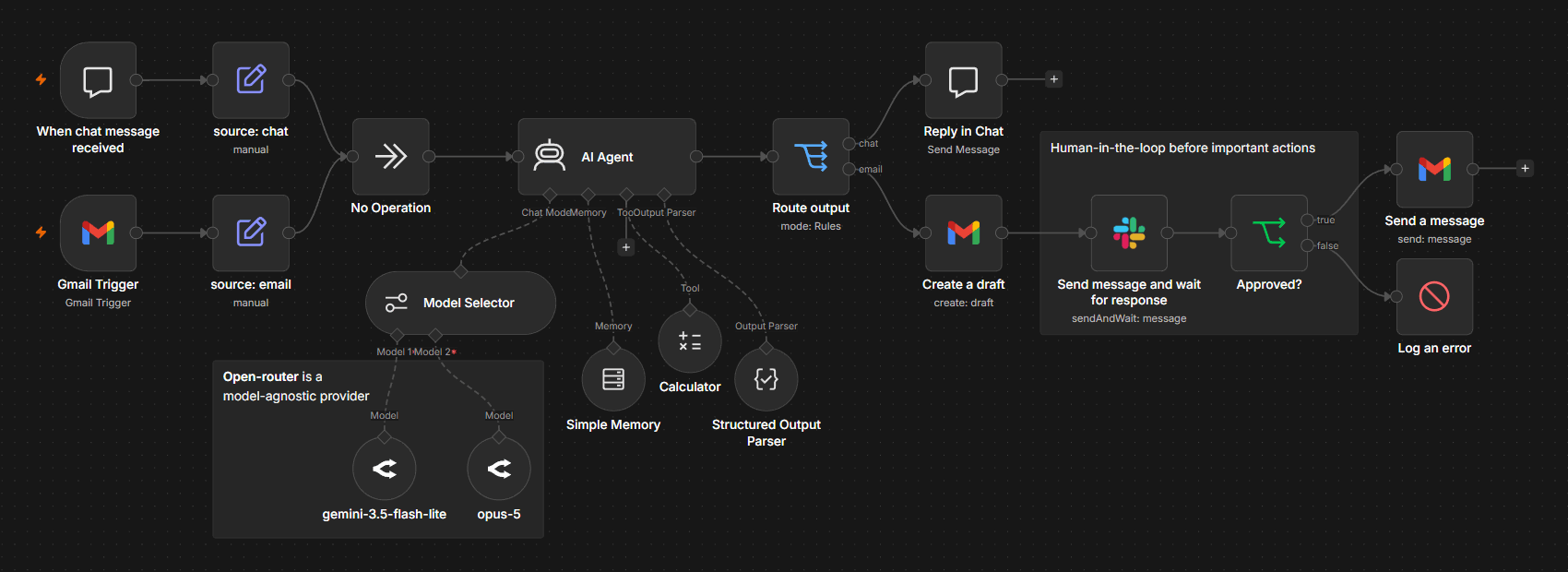
- AI-native features without vendor lock-in: AI Agent nodes handle model routing, tool calling, and memory. n8n scales through queue mode and records every run in execution history, which lets you move automations into production with confidence.
- Enterprise-level governance without enterprise-only pricing: Select features include:
- Single sign-on (SSO)
- RBAC
- Audit logs
- Git-based environments
Choose the best AI automation platform for your team
The right platform should adapt to your requirements, not the other way around.
For technical teams who want infrastructure they control with multi-agent AI orchestration, n8n provides an adaptable architectural foundation at a price that doesn’t penalize sophistication. Fair-code licensing and JSON-based workflow export mean you're never locked in.