



Outdated security models don't work for today's AI-driven systems. While traditional identity access management (IAM) assumes that there's a person behind a keyboard, AI agents require different identification and remediation processes.
This guide covers why AI agent identity management needs its own architecture, what defines an agent's identity, and how to authenticate and authorize them safely in production.
Why traditional identity systems break down for AI agents
Autonomous agents break every one of IAM's assumptions. They authenticate as service principals, then chain calls across half a dozen APIs in seconds. Routing decisions emerge mid-run from the contents of an email or the output of an LLM. Two agents acting on the same OAuth token can execute wildly different actions depending on what the model decides next. And when the audit trail still reads "agent_service_account_3," it's nearly impossible to track.
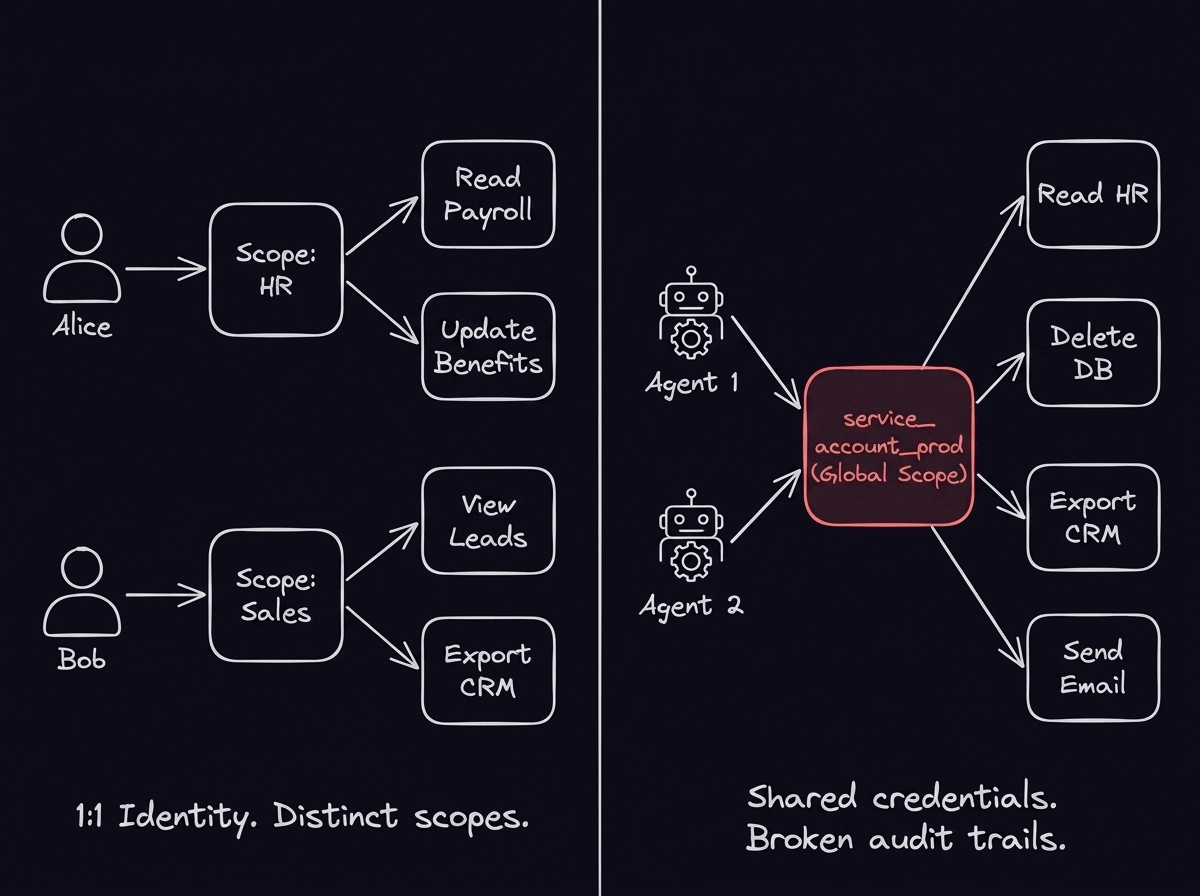
The same identity gaps appear in production AI agent deployments across teams. A single token gets shared between five agents that have nothing to do with each other. Audit logs name the service account and stop there. Permission scopes get copy-pasted from the original prototype, then forgotten.
Several risk patterns show up across AI agent post-mortem:
- Excessive permissions and unrestricted API access: Agents often inherit the union of every scope they might ever need, including production tokens far broader than the workflow actually requires.
- Credential reuse across environments: A single secret rotates across dozens of agents, making identity propagation impossible to trace and credential rotation prohibitively expensive.
- Identity propagation gaps with no execution accountability: Logs show the action but not the decision path, prompt, or model output that produced it. When something breaks, nobody can prove who authorized what.
Agentic systems need a different model — one built around identity propagation, runtime authorization, and dedicated non-human identity governance. AI agent identity management gives each autonomous agent its own credentials, scopes, and audit trails so every action traces back to a specific identity and authorization context.
What defines an AI agent's identity
An agentic identity has more layers than a human one. It combines the credential the agent presents, the delegated authority context it acts under, and the audit chain that ties both back to a real authorizing user.
Here are the pillars that hold this architecture together.
Runtime identity and delegated execution
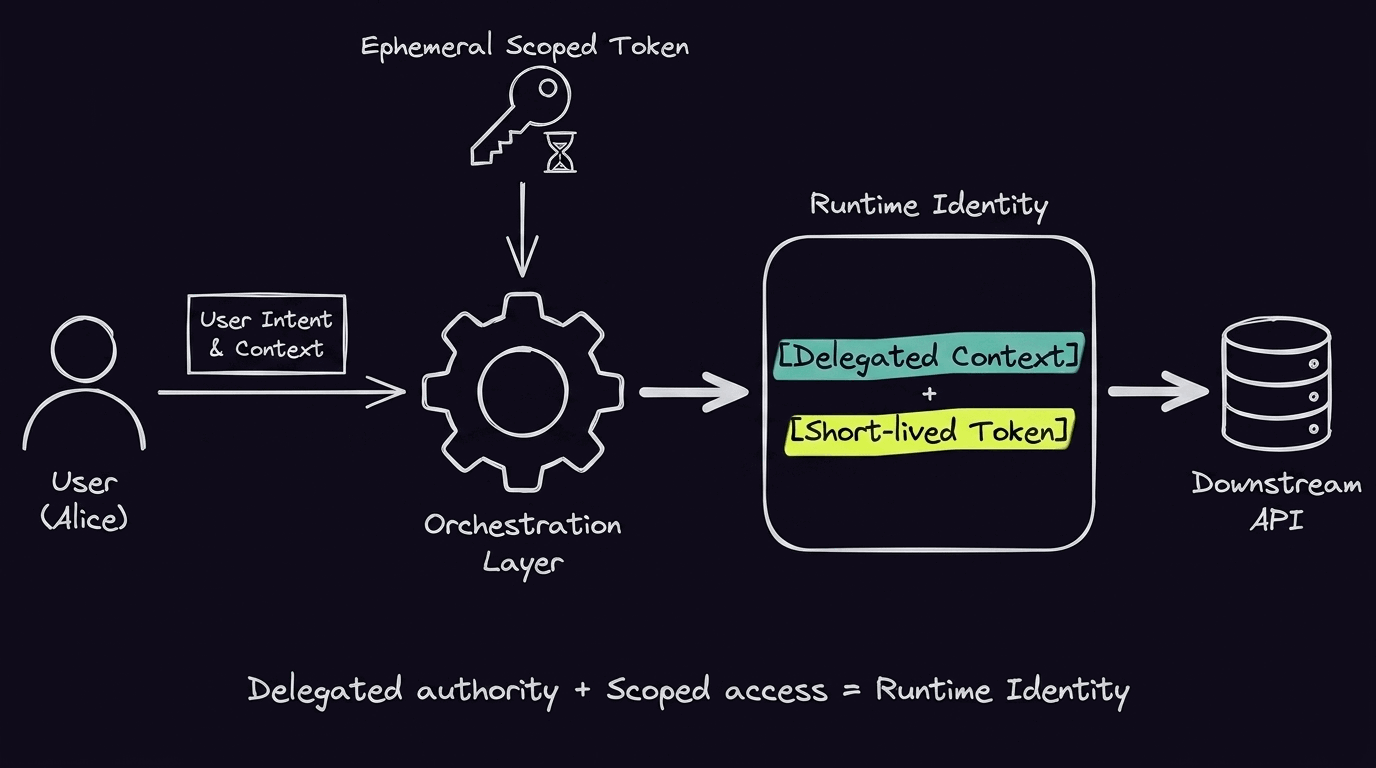
A runtime identity is the identity an agent presents to a downstream system at the moment it acts — not the static credential the agent was provisioned with months earlier.
This matters for a couple of different reasons. First, runtime identity is delegated. The agent acts on behalf of a specific user or workflow context, and that context travels with each call. Second, it's bounded in time. The credential expires when the workflow finishes or the originating user session ends, whichever happens first.
Delegated authorization for AI agents is the model the OpenID Foundation has been formalizing in its recent agentic identity work. A user authorizes the workflow, the workflow scopes that authority down to what the agent actually needs, and the downstream API sees both identities — agent and originating user — when verifying the call. This lets enterprises hold autonomous agents to the same accountability standards as human users without choking throughput.
Scoped permissions and ephemeral access
Scoped permissions are the practical answer to the "agent has prod credentials forever" problem. Instead of granting broad rights, an agent receives a narrow permission set for a specific task, often for a specific length of time. The system issues the access token on execution start and revokes it the moment the workflow exits.
Identity propagation across tools and workflows
Identity propagation makes audit trails meaningful. When an agent calls three APIs in sequence, each downstream system needs to know which user originally authorized the chain. Saying that the agent service account did it isn't enough.
Without propagation, every action collapses into the agent's own identity. With it, a Salesforce log entry still points back to the human who triggered the workflow, the workflow version that ran, and the prompt that produced the decision. This is the layer where most agentic identity platforms still struggle, which is why verifiable credentials and cryptographically signed identity claims are gaining ground in AI identity governance frameworks.
How AI agents authenticate and access systems securely
Securing AI agents starts by separating authentication from authorization. It's easy to confuse the two, which is often how agents end up with permissions nobody approved.
With these distinctions in mind, let's explore the frameworks that allow AI agents to access systems.
Authentication and token-based access
API keys often don't work in AI contexts. They don't expire, don't scope cleanly to a specific user context, and tend to live in environment variables shared across services. OAuth 2.0 with Proof Key for Code Exchange (PKCE) handles most production cases better. For enterprise deployments, single sign-on (SSO) and OpenID Connect (OIDC) tie the agent session to the authenticated user, so agents inherit scoped permissions from the user session rather than from a shared service account.
n8n supports SAML SSO through Okta and other identity providers and isolated credential storage per agent integration. For HTTP-based integrations specifically, the platform centralizes OAuth credential management so refresh tokens, scopes, and grant types stay outside the workflow definition itself. This way, AI agent authentication is a configuration concern, not something hand-rolled per agent.
Least-privilege access control
Role-based access control (RBAC) matters more for agents than for humans because agents act faster than anyone can revoke them. The model is workflow-level: who can edit the workflow, who can execute it, and which credentials each execution can reach. Editors don't automatically get execute rights, and execute rights don't grant credential access.
This maps directly to environment separation between dev, staging, and production. Each tier has its own credential pools and its own RBAC rules, which means promoting a workflow into production has to become a deliberate act rather than a side effect of a deploy script. The underlying role and permission system governs how least-privilege gets enforced day-to-day. Separately, workflow sharing rules determine which collaborators can view, modify, or run each agent.
n8n stores credentials encrypted and separate from workflow definitions; they're never exposed in the workflow JSON. For environment-level isolation, external secrets let you scope vault access per project, so staging credentials stay out of production workflows.
Identity-aware execution monitoring
Identity-aware observability means every agent action is traceable to the credential that authorized it, the workflow version that ran, and the user session that initiated the chain. Without it, AI agent post-mortems devolve into log archaeology and finger-pointing.
Streamline AI agent identity management with n8n
Autonomous AI agents need identity controls that didn't exist when most IAM platforms were designed. That means authentication alone isn't enough. Agents need bounded authorization, propagated identity, and per-execution observability, and those controls have to extend past the IAM platform into the workflow layer where agents actually act. Teams who want their AI agents to behave predictably in production start by treating identity as a workflow-level concern, not an afterthought bolted on after the agent ships.