



The AI maturity framework in Section 2 may suggest a smooth, linear progression. The reality is different. Organizations do not advance evenly through these levels. There is a specific transition point where most enterprises stall, and understanding why is how anyone can reliably scale AI today.
The hardest leap is from Level 2 (Operational) to Level 3 (Systemic). This is the orchestration chasm, and it is where the majority of enterprise AI initiatives plateau or fail.
What Level 2 Actually Looks Like
At Level 2, an organization has real wins to point to. Marketing has a content-generation workflow that saves the team hours each week. Customer support has an AI-powered triage system that routes tickets faster. HR has automated parts of onboarding. Finance uses AI to flag anomalies in expense reports.
These are genuine improvements that deliver measurable value within their respective departments. But they share a common structural limitation: each one is a standalone system built for a single use case. The marketing tool does not talk to the CRM. The support triage system does not connect to the billing platform. The HR workflow cannot reach the IT provisioning system.
This is the pattern KPMG's Q4 2025 AI Pulse Survey captured when it found that 65% of leaders cite agentic system complexity as the top barrier to deployment, a figure that held steady for two consecutive quarters. Individual pilots often succeed. The deeper challenge is that success at the department level does not automatically translate to success at the enterprise level.
Why the Gap Exists
Three structural barriers prevent organizations from making this leap.
The integration barrier. At Level 2, AI tools operate as islands. They receive input from a human, process it, and return output to that same human. To reach Level 3, AI systems need to operate as part of the enterprise's nervous system, reading from and writing to the same systems that run the business: CRMs, ERPs, HR platforms, billing systems, communication tools, and databases, many of which were built long before AI existed. Gartner predicts that over 40% of agentic AI projects will be canceled by the end of 2027 because of escalating costs, unclear business value, and inadequate risk controls. Gartner also notes that integrating agents into legacy systems can be technically complex and costly.
The governance barrier. Department-level pilots can operate with lightweight governance. A marketing team using AI for copy generation needs a usage policy and some prompt guidelines. But when AI systems start accessing customer data from the CRM, processing financial transactions, and making decisions that affect multiple departments, governance requirements expand dramatically. Deloitte's 2026 State of AI in the Enterprise report found that only 21% of organizations have a mature model for governing autonomous agents, while 73% cite data privacy and security as their top concern. The governance infrastructure that worked at Level 2 is fundamentally insufficient for Level 3.
The coordination barrier. At Level 2, each department owns its own AI initiatives. There is no central authority coordinating which systems AI can access, what standards agents must follow, or how cross-departmental workflows should be designed. Moving to Level 3 requires organizational coordination that most enterprises have not built. The same Deloitte research found that 84% of companies have not redesigned jobs around AI capabilities, meaning the organizational structure itself is not yet ready for AI to operate at scale.
The Solution: The Orchestration Layer
The technical answer to bridging this chasm is what analysts increasingly call the orchestration layer. Enterprise demand for this capability is growing rapidly: Gartner reported a 1,445% surge in client inquiries about multi-agent systems from the first quarter of 2024 to the second quarter of 2025. Forrester has introduced an Agent Control Plane research stream and announced a dedicated market evaluation for the category.
The orchestration layer is middleware that sits between AI models and enterprise systems. It serves three critical functions.
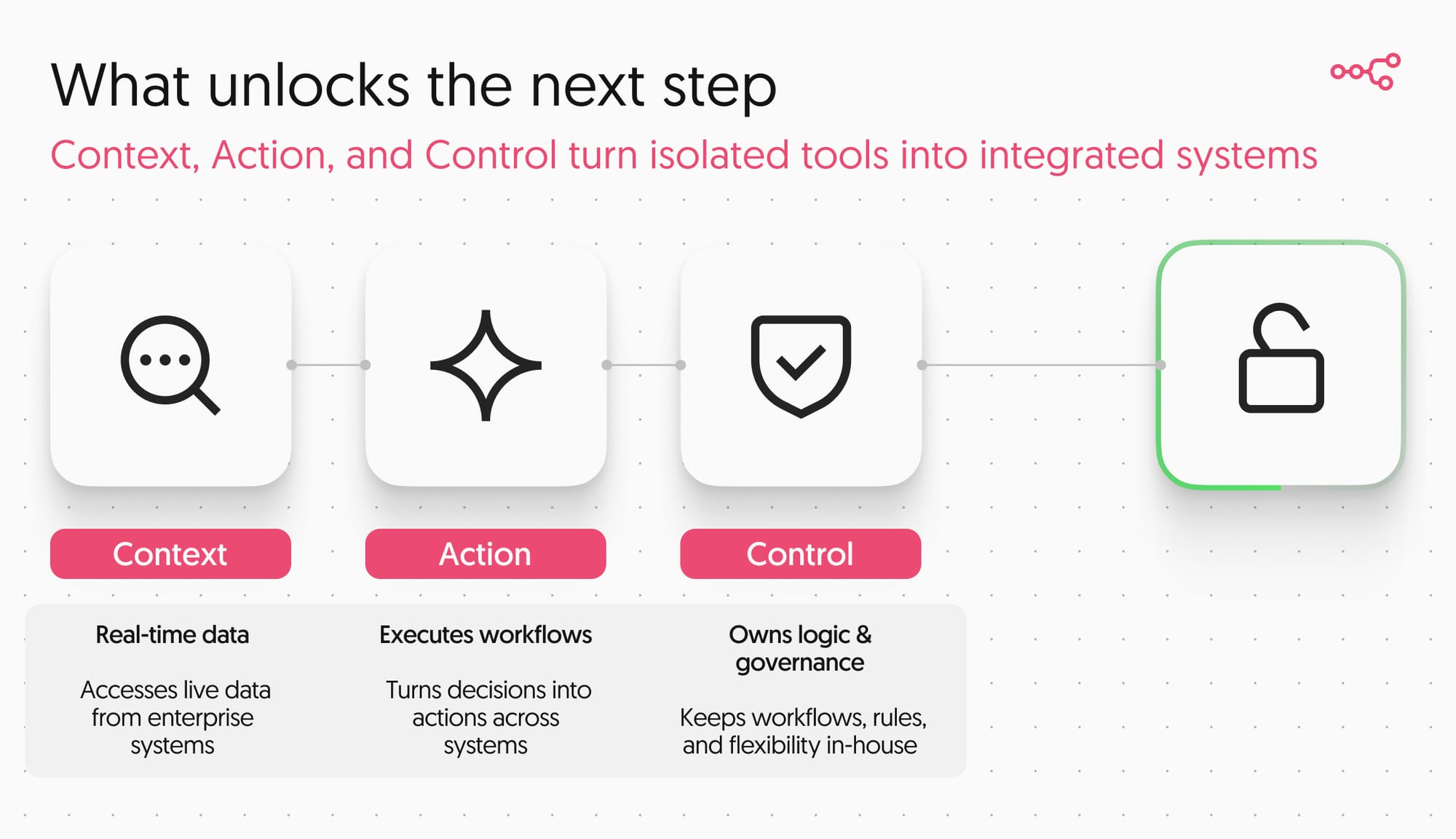
Context. It allows AI agents to fetch real-time data from enterprise systems before making decisions. Instead of operating on whatever information a human pastes into a chat window, the agent can authenticate into the CRM, pull the relevant customer record, check account status, and use that actual data to inform its response. Working from complete, current data is what separates a production system from a demo. Without it, the agent can only reason over whatever a human happens to paste into a chat window.
Action. It allows AI agents to perform write operations, not just read operations. An agent can update a CRM record, create a support ticket, process a refund, send a notification, or trigger a downstream workflow. This is what transforms AI from an assistant that produces text into an actor that produces outcomes. Forrester predicts that by the end of 2026, about a third of B2B payment workflows will use autonomous AI agents, with examples including supplier and buyer dispute management, invoice matching, and payment reconciliation. None of that is possible if agents can only generate text.
Control. It keeps business logic within the enterprise's own infrastructure rather than inside a specific AI vendor's platform. When your workflows, data connections, and business rules live in your own orchestration layer, you can swap the underlying AI model, whether moving from one commercial provider to another or adopting an open-source alternative, without rebuilding the entire system. In a market where AI capabilities shift monthly, this architectural flexibility is not optional.
n8n Enterprise. Scale robust, reliable workflows that meet compliance and governance standards. Find out why 34% of Fortune 500 companies trust n8n's advanced security and DevOps features to build and monitor business-critical AI workflows. Learn more about n8n Enterprise.
What This Looks Like in Practice
The organizations that have successfully bridged this chasm made the same architectural choice. Rather than deploying a better standalone model, they connected AI to the systems the business actually runs on.
In Practice: Wells Fargo deployed an AI assistant to 35,000 bankers across roughly 4,000 branches, connecting the agent to internal procedures and reference material. The result: bankers retrieve the information they need in about 30 seconds, down from up to 10 minutes of manual searching, and roughly 75% of relevant searches now run through the agent. JPMorgan Chase built a proprietary platform, LLM Suite, which reached 200,000 onboarded users within eight months, while its Contract Intelligence (COiN) system performs the equivalent of 360,000 hours of legal and loan-officer work annually. In both cases, integration was what produced the breakthrough, and the choice of model was secondary.
On the other side, Sweep's 2025 post-mortem of stalled enterprise AI initiatives found that organizations failed because their "systems were illegible." Autonomous agents exposed years of hidden metadata debt in platforms like Salesforce. These companies had tried to modernize intelligence without modernizing how work gets done.
Why Orchestration Matters More Than Model Selection
A common mistake at the executive level is treating AI adoption as primarily a model-selection problem. "Which AI should we buy?" is the wrong first question. The right question is: "How will AI connect to our existing systems, data, and workflows?"
The AI model is the reasoning engine. It is important, but it is interchangeable. What gives that reasoning engine the ability to do useful work inside your organization is the layer that connects it to your actual data and tools. Without that layer, even the most capable model in the world is limited to answering questions based on whatever a human manually provides.
This is why the orchestration layer is the single most important architectural decision an enterprise makes in its AI journey. It determines whether AI remains a collection of departmental tools or becomes an integrated part of how the business operates. It is also where governance gets implemented in practice, because it is the single point through which all AI interactions with enterprise systems flow. Authentication, role-based access, audit logging, data classification, and compliance checks can all be enforced at this layer rather than rebuilt independently for every AI application. As the Cloud Security Alliance's 2025 assessment reported that 26% of organizations had comprehensive AI security governance policies in place. The orchestration layer is where the other three-quarters can close that gap.
What Comes Next
Understanding why the chasm exists is one thing. Crossing it is another. Is your organization treating AI adoption as a model-selection problem, or as an integration and governance problem? The answer usually predicts whether your pilots scale or stall.
The next post in this series turns diagnosis into action: a phased playbook for advancing through the maturity levels, with concrete steps, realistic timelines, and the organizational changes each transition demands.