
AI used to exclusively wait for human input. Autonomous AI agents flip that pattern. Given a goal, they plan, take actions across tools and services, and check the results on their own. The shift from advice to action makes them powerful, but it also makes them genuinely risky.
Let’s take a look at what AI agents are and how to use them effectively and safely.
What are autonomous agents?
An autonomous AI agent is a system that pursues a goal with little to no human intervention. It perceives its environment, decides what to do, and takes actions. The system decides and acts rather than simply responding.
Autonomous AI agents are distinct from regular automation, having environmental awareness, goal-oriented behavior, adaptability, and persistence across a task. They focus on an objective; you give it purpose, and it works out the steps.
How do autonomous agents work?
Autonomous AI agents work through a continuous loop of checking their environment, reasoning through steps, and performing actions. These systems own multi-step workflows using these key components:
- Inputs: The agent needs inputs, like a prompt, a webhook event, or a database row.
- Reasoning core: Agents use a cognitive system to break a goal into a step-by-step process. This reasoning core is typically an LLM.
- Memory: AI memory lets agents carry context across a multi-step task instead of resetting each turn.
- Tools: Agents use connections to application programming interfaces (APIs), databases, and other services to execute real actions. For example, an agent could send an email or update a record.
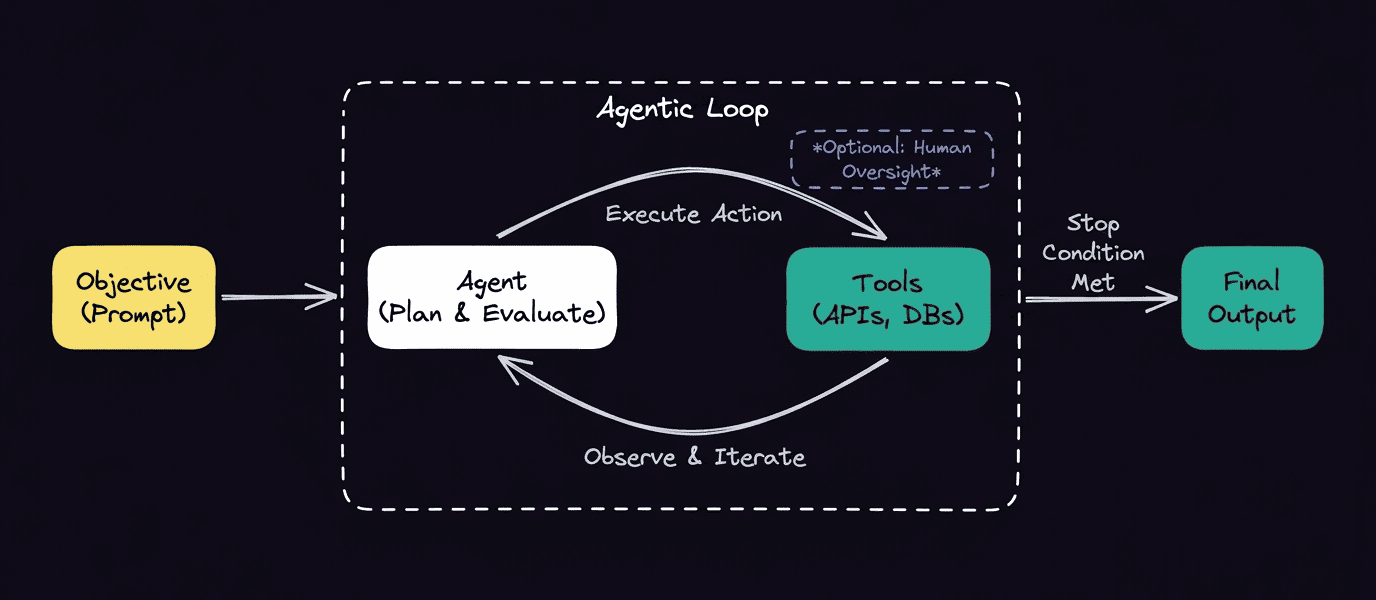
These elements allow agents to consistently observe, plan, act, and iterate. They process information and adapt as they go.
Some agents run solo. Others operate as multi-agent setups, where a coordinator delegates sub-tasks to specialists and several autonomous agent systems work in tandem.
Coordination raises the ceiling on what agents can do, but it also widens the blast radius when something breaks: more agents, more tools, and more places for a single error to compound. Teams need strong AI guardrails to control what agents can access and what actions they can perform.
Levels of AI agent autonomy
Autonomy is a spectrum. Most teams adjust it gradually, granting more independence as tasks call for it. Three broad tiers cover the range:
- Rule-based and workflow automation: The system follows predefined logic and makes no real decisions of its own — think a scheduled job that moves data along a fixed path. Reliable and fully predictable, but not autonomous in any meaningful sense.
- Partially autonomous: The agent plans and acts, but a human stays in the loop to approve high-stakes steps. For example, a support agent can draft a refund but waits for sign-off from a person. Most production deployments sit here as the method balances speed with oversight.
- Fully autonomous: The agent operates with broad independence and a human only intervenes on exceptions. This tier demands the strongest guardrails and constant oversight.
Benefits of AI autonomous agents
Done well, autonomous agents reduce operational costs, accelerate tedious tasks, and reinforce consistency. The benefits cluster into three main areas:
- Productivity and cost: Agents take on decision-heavy, repetitive tasks at scale. This frees teams for work that actually needs human judgment, boosting productivity and lowering operational costs.
- Speed and adaptability: Because they process information and act in real time, agents respond to changing inputs without waiting in a queue. Agents adapt as conditions shift, completing actions quickly and efficiently.
- Consistency and customer experience: Agents can work 24/7, so service stays steady and resolutions reach customers faster.
Common autonomous AI agents use cases
The most common applications today are in software and operations. Here are a few popular examples:
- In customer service, agents power chatbots and virtual assistants that resolve tickets instead of just deflecting them.
- In IT ops and software delivery, they triage incidents, watch systems, and open fixes.
- In supply chain and logistics, they track inventory and reroute orders around disruptions.
- In finance, agents monitor transactions for fraud and automate invoice processing.
- In marketing, they can track campaigns, create customer personas, and optimize ads.
- In sales, agents can triage calls, schedule follow-ups, and build sales decks.
Mitigating autonomous AI risks through governance and oversight
The same independence that makes agents useful makes them a risk. When an agent acts across tools, data stores, and other agents, its decisions and errors can compound.
A single bad inference cascades: a misread instruction becomes a wrong action, which evolves into a corrupted record three systems away. The privacy and security stakes are high — the agent touches real data and live systems rather than a sandbox. And the chain of reasoning might not be visible, making audits and iteration extremely difficult.
AI Governance needs to work alongside agents at every stage. When agents can make decisions in real time, vetting the underlying model is necessary but no longer sufficient.
People require end-to-end workflow governance when using autonomous agents, meaning oversight of every step of the process, every tool called, and all data accessed, with human supervision at the points that matter.
How to mitigate AI agent risks
Teams need deterministic, rule-based steps with agentic execution, so an agent’s freedom stays bound by logic you define rather than left to chance. They need software providing human-in-the-loop approval steps to gate tool calls, making agents pause while a person reviews the intended action. Then, the action runs only on approval.
n8n is a source-available automation platform that uses deterministic and agentic workflows, and it enforces governance through multiple capabilities. AI Agents use a visible loop: They reason about which tool to call, execute actions, evaluate results, and iterate the process. This happens on a visual canvas where reasoning and tool calls are transparent and auditable.
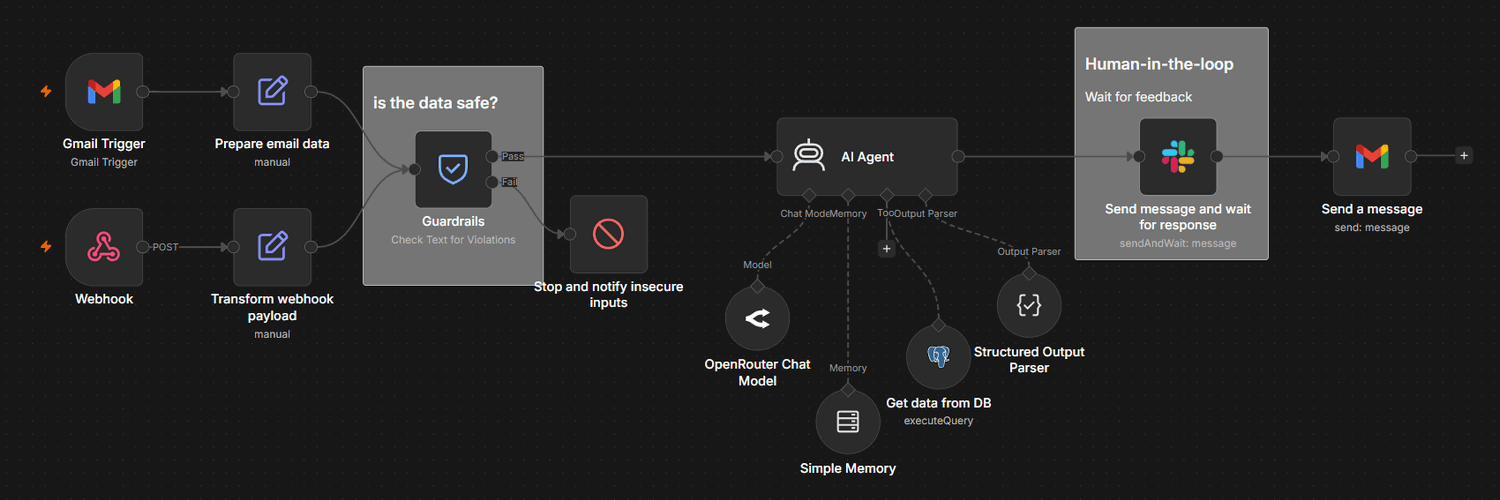
Here are some of n8n’s governance capabilities:
- Conditional branching with IF and Switch nodes route agent decisions and enforces stop conditions, so a runaway loop has a defined exit.
- Human-in-the-loop nodes provide control for when workflows stop and wait for human review.
- Simple memory nodes keep context persistent across a long task, preventing drift and promoting compliance through extended operations.
- Execution history records every agent decision and tool call as a full audit trail — the observability that provides context you can inspect after the fact.
- Error handling and retry logic offer granular control into how agents respond to failures.
Deploy autonomous AI agents confidently
Autonomous agents are an engineering and platform commitment. They’re a system that plans, acts, and reaches into production, and they require ongoing attention to stay effective and secure. Success comes when you start narrow and create transparency and feedback loops before scaling.
n8n gives you a foundation to build on. Our platform’s canvas provides a visible environment, so building, governance, and iteration are simple. With a transparent process, full execution history, and human-in-the-loop controls, n8n lets you design and deploy agents safely.