
An external API can work perfectly one day and start breaking the next, all because a provider changed a response without warning. If you aren't watching for those changes after deployment, they can slip into production unnoticed.
API contract testing helps catch those changes before they cause downstream failures by verifying an API still behaves as expected. It’s an important safeguard during development — and even more valuable when paired with runtime validation after deployment.
Why breaking API changes slip past testing
Most testing tells you whether an application works at a specific point in time. It doesn't guarantee an upstream API will keep behaving the same way after your code gets deployed.
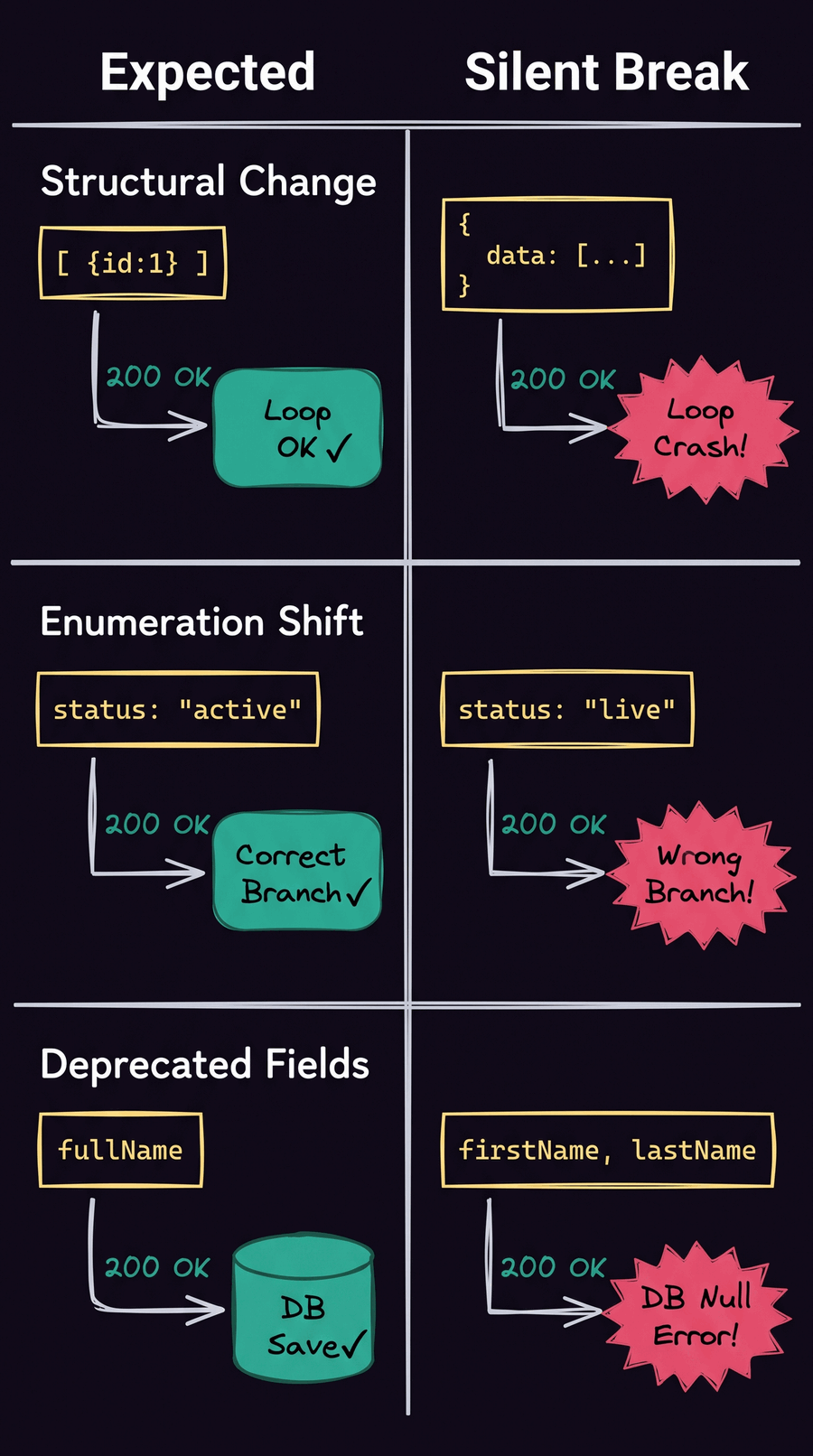
A provider can rename a field, change a data type, or make a previously optional value required weeks after your test suite passes. If nothing checks those responses in production, the change may go unnoticed until a downstream workflow fails.
Imagine a payment API that returns an amount field as a number. One day, the provider updates the endpoint and starts returning that value as a string.
The API still responds successfully, so the request doesn't fail. But a workflow that expects a numeric value may calculate the wrong total or stop processing altogether. While the API is still available, the contract changed, and nothing detected the difference before it reached production.
What API contract testing actually checks
API contract testing is what catches changes before they cause problems downstream. It verifies that the interface between a provider and consumer still matches the agreed contract.
That contract defines how the two systems communicate, including the expected request and response structure, required fields, data types, status codes, and other behaviors the consumer depends on. Consistent contracts also make data mapping between systems more reliable because downstream workflows can trust the structure they’re receiving.
Teams typically verify those expectations in one of two ways:
- Consumer-driven contract testing: Starts with the consumer's expectations and checks that the provider still satisfies them
- Schema-based validation: Compares requests and responses against a shared specification, like an OpenAPI document or JSON Schema, to confirm they follow the agreed format
Both approaches help surface breaking changes before they reach production, even when the API itself continues to respond successfully.
Contract testing vs. integration testing vs. schema validation
These three terms are similar, but they answer different questions.
Integration testing takes the broadest view. It exercises multiple components together to verify an end-to-end workflow, like creating an order through an API and confirming it appears in a database. But if an API response changes unexpectedly, an integration test may simply report that the workflow broke. These tests are valuable before deployment because they reveal issues across service boundaries, but they don't necessarily identify why an interaction failed.
API schema validation focuses on a single request or response. It compares a payload against a specification, such as a JSON Schema or OpenAPI document, to confirm the expected fields and JSON data types are present. This makes it an effective way to detect malformed payloads, but it doesn't verify whether the schema reflects what consumers actually rely on.
API contract testing validates the agreement between a provider and its consumers. Whether the contract comes from consumer expectations or a shared schema, the goal is the same: Detect breaking interface changes before they impact downstream systems. It provides more context than a failed integration test and a broader guarantee than validating an individual payload on its own.
Enforcing the contract inside an automation workflow
Contract testing is typically part of a CI/CD pipeline, where it verifies that a provider and consumer still agree before you publish workflows to production. While that's an important safeguard, it doesn't detect provider changes weeks later.
Once a workflow is live, every API call is another opportunity for the contract to drift. Without runtime validation, a passing test suite only tells you the contract was honored at deployment — not that it's still being honored today.
Instead of treating contract validation as a separate service, you can build this validation into your workflows. If you’re using n8n, a source-available AI workflow automation platform, you enforce contracts every time a workflow calls an API.
Create tests for each API you use with the HTTP Request node. Every API response can be checked before downstream steps use it, and every validation run is recorded in n8n's execution history. However, this isn’t automatic, and it doesn’t work with built-in nodes.
Rather than hunting through logs after a workflow fails, you can inspect exactly what the provider returned and when the contract changed. The result is an auditable record of every validation, making it easier to diagnose issues as soon as they happen instead of after they've spread through your systems.
A typical workflow might look like this:
- Call the API: Use the HTTP Request node to retrieve data from the provider.
- Validate the response: Use a Code node to write custom JavaScript or Python code that compares the response against the expected schema before the workflow continues.
- Handle violations: Add an If node to separate valid responses from contract violations.
- Notify the right people: Route failed validations to Slack, email, or your ticketing system instead of letting the workflow continue with malformed data. For sensitive workflows, you can also introduce human oversight before any downstream actions run.
This approach complements contract testing instead of replacing it. Your test suite confirms the contract before deployment, and n8n continues enforcing it every time the workflow runs, helping you catch breaking changes the instant they happen.
A checklist for catching contract breaks before customers do
Even the best contract tests are only as effective as the process around them. Teams often validate the happy path before deployment, then assume the API will continue behaving the same way in production. In reality, providers evolve over time, schemas change, and consumers adopt new dependencies.
Before you rely on API contract testing in production, make sure your approach covers the following:
- Validate the full contract: Don't limit validation to the fields your workflow uses today. Changes to optional or unused fields can still signal a breaking change that affects future consumers.
- Check responses where they're used: Validate API responses as close to the HTTP request as possible so downstream steps never process malformed data.
- Version contracts intentionally: Update and track contract versions so expected changes are distinguishable from unexpected ones.
- Alert on violations immediately: Notify the right team as soon as a contract check fails instead of waiting for a downstream workflow to surface the issue.
- Treat execution history as evidence: Keep a record of every validation run so you can quickly identify what changed, when it happened, and which workflows were affected.
- Decide how you'll monitor production: Some APIs should be validated on every request, while others are better suited to scheduled health checks that look for schema drift between releases.
Keep API contracts reliable after deployment
API contract testing isn’t a one-time exercise, and ongoing enforcement is just as important as the tests that run in CI.
Building validation into your production workflows catches damaging changes. Every API response can be checked before downstream systems rely on it, contract violations can trigger alerts instead of silent failures, and each validation run becomes part of an inspectable history. Those patterns help you detect breaking changes as they happen, giving you confidence that the workflows your business depends on continue to behave as expected.
These practices apply regardless of tooling. If you're using n8n, you can build runtime validation into your existing workflows today. Get started with n8n Cloud or self-host the Community Edition.