
Retries are a normal part of automation. When an API times out or a network connection drops, workflows often try the request again automatically. But without safeguards, those retries can create duplicate operations instead of safely completing the original request.
API idempotency is one way to solve that problem. In this guide, we’ll explore the most common patterns for preventing duplicate operations and how to implement them in your workflows.
Why automated retries make duplication risk worse
Retries are usually a good thing. If a request times out or a network connection drops, trying again often succeeds without anyone having to intervene. The problem is that workflows can retry automatically, long after a person would have stopped to investigate.
Imagine a workflow that creates a payment through a third-party API. The payment succeeds, but the response never reaches your workflow because the connection times out. Assuming the request failed, the workflow retries the same API call. If the API can't recognize that it's already processed the request, it creates a second payment instead of returning the original result.
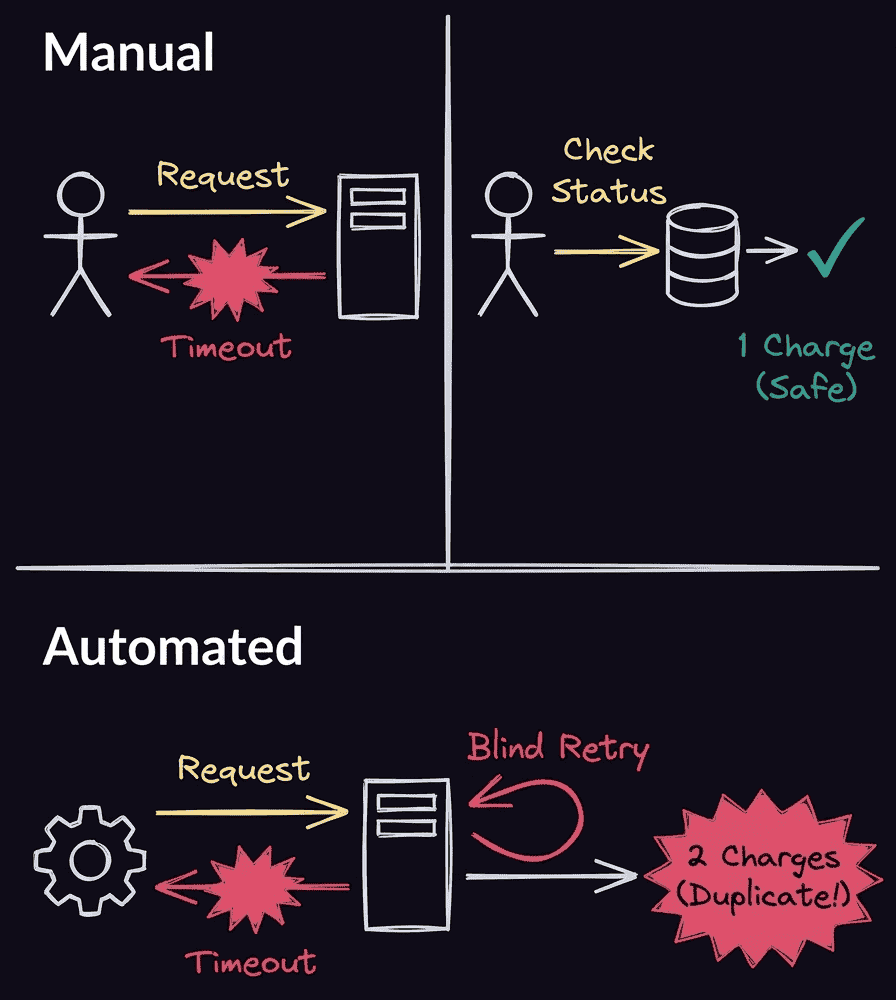
That's why API idempotency matters. In mathematics and computer science, idempotency is what describes an operation that produces the same result no matter how many times it's repeated.
An idempotent API recognizes repeated requests and produces the same result instead of repeating the underlying operation. That allows workflows to retry without creating duplicate side effects.
Which HTTP methods are idempotent by default
Some HTTP methods are idempotent by definition, while others depend on how your application is designed. Here’s a quick overview:
Knowing which HTTP methods are safe to retry is a good starting point. The harder challenge is making POST and PATCH requests retry-safe, since they’re the methods most likely to create duplicate operations. That’s where patterns like idempotency keys and request deduplication become essential.
Core patterns for building idempotent APIs
There are multiple ways to make an API idempotent. The right approach depends on what your endpoint does, how it handles state, and where duplicate requests are most likely to occur.
Here are the most common patterns.
Idempotency keys
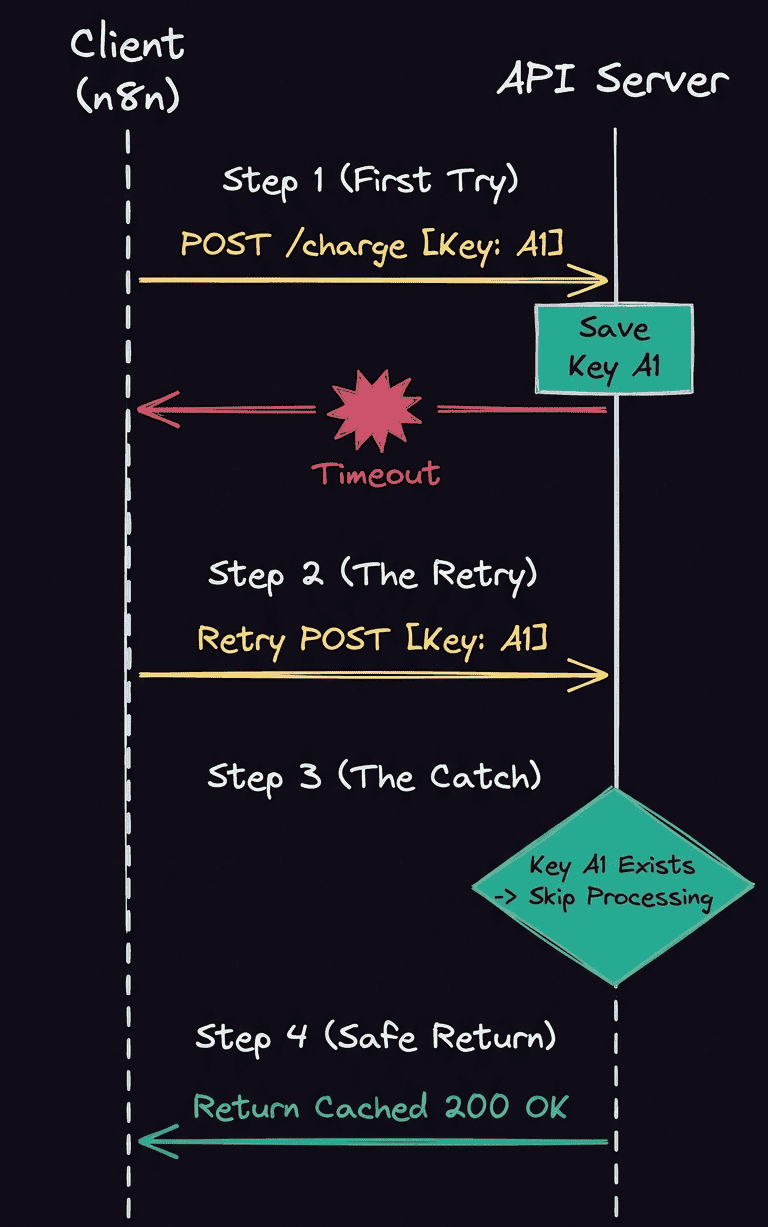
The client generates a unique idempotency key and sends it with the request, usually in an Idempotency-Key header. The server stores the first successful response associated with that key. If the same request arrives again with the same key, the server returns the original response instead of processing it a second time.
Natural idempotency
Some operations are inherently safe to repeat. Updating a user's email address to the same value produces the same final state no matter how many times the request is sent. The same applies to idempotent REST API operations like replacing an entire resource with a PUT request. When possible, designing operations this way reduces the need for additional deduplication logic.
Deduplication logs
Instead of relying on the client, the server keeps a record of processed request IDs or event IDs. Before performing any side effects, it checks whether that identifier has already been processed. This approach is especially useful for inbound webhooks and event-driven systems where duplicate deliveries are expected.
Conditional writes and locking
Databases can help enforce idempotency. Unique constraints, optimistic locking, or conditional updates prevent duplicate records from being created, even if multiple identical requests arrive at the same time. This shifts part of the responsibility for idempotency into the persistence layer.
How n8n enforces idempotency at the orchestration layer
The patterns above are universal. But implementing them usually means writing custom retry logic, deduplication checks, and supporting infrastructure.
n8n is a source-available AI workflow automation platform that brings those patterns together at the orchestration layer.
Enforcing safe patterns becomes even more important when workflows grow in complexity and interact with more external systems where retries, tools, and long-running executions increase the chances of duplicate actions if idempotency isn't built in.
Whether you're building API integrations or AI-powered workflows, these n8n features help enforce idempotency in production.
Generate idempotency keys with execution.id
One of the simplest ways to make outbound requests retry-safe is to generate a unique idempotency key for each workflow execution. n8n exposes execution.id as part of the workflow execution context, giving every run a built-in unique identifier. Pass that value as an Idempotency-Key header in your HTTP Request node, and retries from the same workflow execution won't be treated as new requests. However, if a workflow is manually retried or re-triggered, it receives a new execution.id. For cross-retry idempotency, generate a key from the input data (e.g., order ID) rather than execution.id.
Retry requests safely
The HTTP Request node includes built-in retry controls that let you handle rate limits, including Max Tries and Wait Between Tries, to handle temporary failures automatically. Automatic retries are only safe when the endpoint supports idempotency, either through idempotency keys or another deduplication mechanism. Otherwise, every retry risks creating a duplicate operation instead of completing the original request.
Deduplicate inbound webhooks
Idempotency isn't just about outbound requests. If a third-party service delivers the same webhook multiple times, your workflow needs to recognize those duplicates before processing them. A Code node with custom JavaScript or Python can extract the webhook's delivery ID, check it against the Data table node or a database, and stop the workflow if that ID has already been processed.
Centralize failed executions
Retries won't catch every failure. When a workflow still can't complete after exhausting its retries, the Error Trigger node lets you capture the failed execution, log the associated idempotency key, and route it to a retry queue or alert. That gives you a recoverable failure instead of a silent one.
Build custom retry logic
Some APIs need longer backoff periods or more retry attempts than the HTTP Request node provides out of the box. In those cases, you can build a custom retry loop with Set, If, and Wait nodes, giving you full control over retry timing when an endpoint doesn't return a Retry-After header or requires a more conservative backoff strategy.
Common retry mistakes and how to avoid them
Retries get risky when the workflow doesn’t know what happened on the first attempt. You might try a POST request even though the server already processed it, or accept the same webhook twice and run the entire workflow again.
Idempotency keys can also cause problems if the same key gets reused for unrelated operations. And if a retry loop has no upper limit, a persistent error could keep consuming executions without ever resolving itself.
Do this quick retry-safety check before putting a workflow into production:
- Find the POST and PATCH requests in the workflow and check whether those APIs support idempotency keys.
- Keep the same key when retrying an operation; for new operations, use a new key.
- Check webhook event or delivery IDs before processing incoming data.
- Make sure downstream endpoints can handle repeated requests before enabling automatic retries.
- Put a limit on how many times a failed request can retry.
- Keep an eye on execution counts when using custom retry loops so a persistent failure doesn’t eat through your quota.
If you’re not sure whether a workflow will behave safely when something gets retried, ask the n8n community for a second set of eyes.
Build retry-safe API workflows with n8n
Idempotency makes API workflows more reliable. Instead of worrying about duplicate payments, webhook deliveries, or failed retries, you can design workflows that recover predictably when requests don't go as planned.
n8n allows you to do that. You can generate unique execution IDs, configure retry behavior, deduplicate inbound events, and handle failures from a single orchestration layer instead of stitching those capabilities together yourself.