

Roles-based access control (RBAC) for AI agents can be risky. Unlike human users, agents operate at machine speed while making decisions with varying degrees of autonomy. In these environments, fixed roles, broad permissions, and static access control create serious security and governance issues.
This article explains why traditional RBAC is insufficient in agentic systems, what dynamic authorization looks like, and how to implement AI agent access control in production settings.
Why RBAC fails at the agentic layer
Standard RBAC assumes that once you assign a role, the user or account will act predictably. This works well for human users, but it’s not always applicable to machines.
Human actions give RBAC tools enough time to change access and maintain security. But autonomous systems move differently and react much faster than human users do. By the time traditional RBAC tools catch up, the model has likely executed thousands of multi-step tasks.
Regular users also use human logic and ethics and stop before performing dangerous tasks, like deleting data or sharing sensitive information.
Because agentic behavior changes dynamically with input, relying on a rigid access management system amplifies risks. Here are four common ways static RBAC breaks down in agentic environments.
Over-permissioned actors without judgment
When IT teams define roles for AI systems, they often grant wide capabilities so models can solve a range of tasks. However, agents usually don’t judge if an action is safe or ethical in the way humans do. If teams don’t build least privilege AI agents, a single compromised or misbehaving agent could cause serious damage. For instance, AI with deletion permission could misinterpret a prompt and erase a company database. One example is a Claude-powered AI agent that deleted PocketOS’s entire production database and its backups. This agent had broad, root-level permissions and violated every principle it was given knowingly.
Role expansion and granularity failure
As agents develop more capabilities and organizations find more use cases in production, IT teams might create thousands of hyper-granular roles to control agent behavior. However, the number of distinct tasks may grow faster than teams define and maintain new roles. Too much granularity leads to permissions sprawl and creates maintenance problems.
Machine-speed failure amplification
People make mistakes or take malicious actions at human speed, which gives role-based access controls and admins enough time to react. Autonomous systems can execute multi-step actions in milliseconds. Consequently, errors and malicious behaviors can spread or escalate in a system before technical controls or a human reviewer notices them.
The data-layer gap: RBAC in retrieval
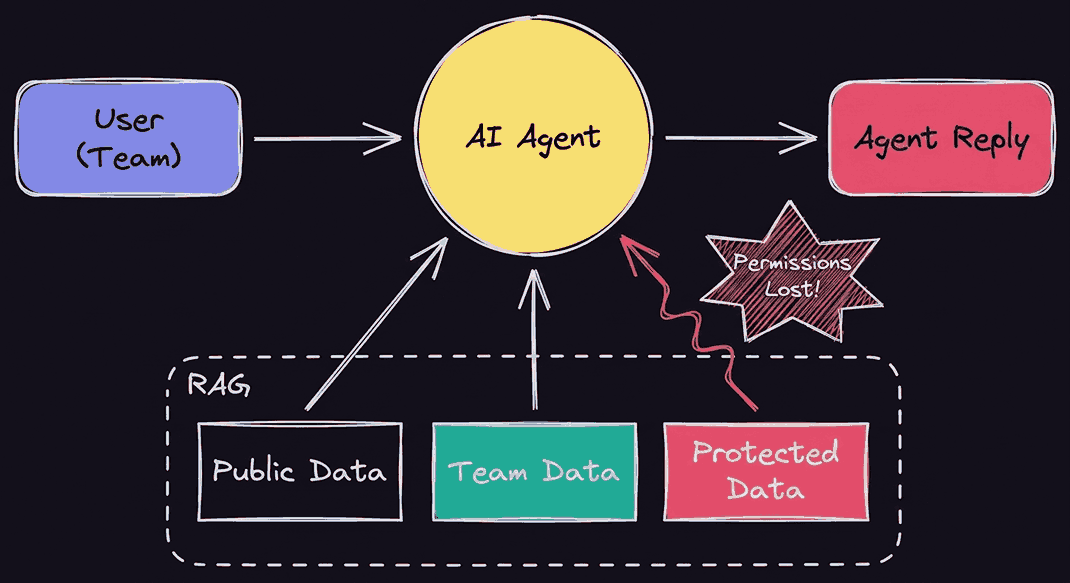
RBAC is often not enforced at the data retrieval layer. AI agents frequently retrieve information from knowledge sources like vector stores, APIs, and databases without consistently preserving the permission context associated with that data. Without real-time authorization checks, agents have no way of verifying what systems and data they have permission to access. This is one of the most overlooked gaps in AI agent access control, and it compounds the risks associated with other failure points.
What replaces RBAC in agentic systems
Organizations need a different type of access control for AI agents. They should choose a new model that can keep up with the speed of automated workflows.
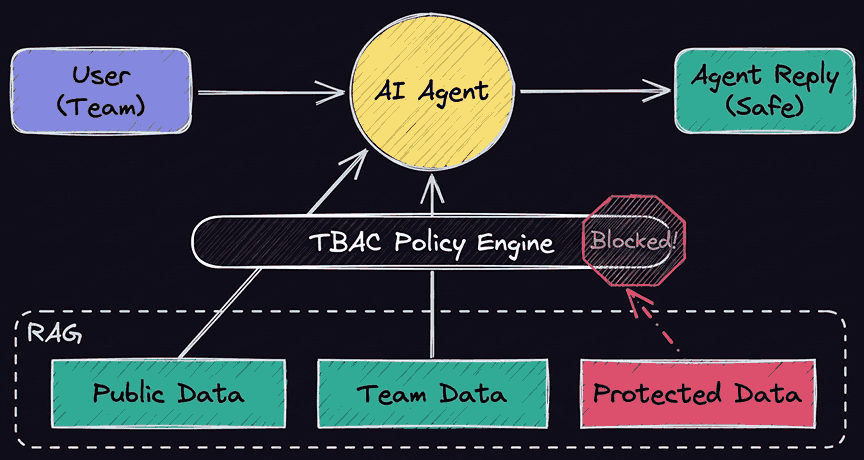
Task, tool, and transaction-based access control (TBAC) is currently gaining traction as an alternative. Unlike traditional control models that focus on identity, TBAC looks at the specific task the agent is completing in real time. It checks the active context and request conditions before allowing an API call or data request.
Agents can still complete useful work, but access remains scoped to the current task rather than a broad set of permissions.
Here are the three main pillars needed to make this security model work.
Central policy engine and runtime enforcement
Teams use a centralized policy engine to reduce permissions sprawl. It evaluates each agent action against a defined set of security, compliance, and business-logic rules. The engine analyzes factors like payload, environmental elements, and the specific API call. The policy engine makes the final decision on whether to allow the action.
A firm identity and declared purpose for every agent
A verifiable digital identity is similar to a service account but with more metadata and tighter context. It should link to an agent’s purpose, the tools it’s allowed to use, and the scope of its data access. Without this security foundation, runtime policy engines may not have enough context to make accurate enforcement decisions.
Enforcement that sits outside the agent
Allowing agents to enforce their own security rules makes them vulnerable to prompt injection attacks. Malicious inputs could cause the agent to take actions that a distinct enforcer engine would flag as suspicious and block. Security at an external layer or API gateway enforces reliable, deterministic enforcement.
RBAC, AI agents, and compliance requirements
AI agents processing regulated data face demanding compliance requirements. HIPAA, GDPR, and SOC 2 have security and access control expectations companies must apply to their agentic workflows. Organizations that fail to do so could face legal issues.
Teams need to show real-time data protection and security across relevant compliance frameworks:
- GDPR Article 32: This regulation requires companies to implement appropriate technical processes to securely handle personal data. Agents operating with broad permissions may create security risks by sharing details in outputs.
- HIPAA Technical safeguards and ePHI: This requires organizations to protect patient data at rest and in transit so it remains confidential and accessible to only authorized parties. Agents accessing ePHI need to face task-scoped enforcement, and their actions should generate full audit trails to prove compliance.
- SOC 2 access control criteria: To comply with SOC 2, auditors need evidence that agent access follows defined policies and that enforced permissions occurred at runtime. Showing the roles assigned at setup won’t be sufficient.
Passing modern audits requires technical teams to prove that their autonomous systems operate within approved security and compliance controls. Workflow automation platforms like n8n make this possible and intuitive.
n8n’s node-based canvas provides simple observability and auditability through a visual interface. Teams can verify input and output of every run, including tool calls, credential uses, and decisions. This provides a thorough, audit log for each execution.
n8n helps secure sensitive information to comply with regulations like HIPAA and GDPR. Agents process data, and the tool’s execution data redaction limits exposure by removing PII from audit logs before storing them.
Implementing RBAC in agentic workflows
Many organizations continue to use RBAC because it’s already part of their security program. Still, teams can make that setup much safer by applying task-based rules to existing roles and logging every action.
Instead of giving agents broad access through static roles, teams add controls evaluating requests before execution. This means tying access to specific tasks and checking permissions at runtime, and creating clear audit records.
Follow these best practices to achieve safe AI agent access control:
- Classify projects and give specific permissions: Group tools by their exact business purpose. You can use n8n’s custom project roles to set up tight boundaries so each team member only has access to the appropriate workflows and projects. This reduces sprawl, but it doesn’t remove the need for a separate policy engine for AI agent identity management.
- Define agent purpose as a machine-enforceable constraint: Every agent should have a clear purpose that security controls can verify before granting access. If an agent’s actions fall outside its defined scope, enforcement should block them automatically.
- Treat permission policies as code: Access policies should live in version control, and teams should test them like any other piece of infrastructure.
- Scope spawned agent permissions explicitly: Isolate spawned AI agent permissions from the parent workflow. With n8n, you can easily ensure each sub-workflow runs with its own credentials and data access boundaries.
- Use audit logs as an operational feedback loop: Track agent control, and keep a detailed record of every run. n8n’s log streaming can connect to a security information and event management platform for real-time agent activity monitoring with minimal custom instrumentation.
Start with a pre-built AI agent workflow
Standard role-based security can’t keep up with fast, autonomous systems. Relying on static roles and permanent permissions gives AI agents broad power and opens companies up to breaches and compliance gaps. Upgrading to a dynamic and context-aware model strengthens protection for enterprise data.
You don’t need to start this transition from scratch. Take incremental steps to apply TBAC principles to existing RBAC frameworks by scoping agent access to specific tasks and building audit trails that reflect real agent actions.
n8n gives teams better control over AI agents. Explore our pre-built AI agent workflows to see our security in action. Build a RAG chatbot for company documents or a database chat interface to get started today.