
Building one AI agent to handle a task is simple. The real headache begins when you need to build workflows where multiple agents must coordinate tasks across different systems. Developers often end up writing custom code just to make tools collaborate.
The agent-to-agent protocol — also called the Agent2Agent or A2A protocol — solves this problem by giving different agentic systems a common language for collaboration.
But how does it work? Let’s start with the basics.
What is agent-to-agent (A2A) protocol?
Google introduced the A2A protocol in April 2025 as an open standard for AI systems to communicate. It uses HTTP as the primary transport, JSON-RPC for structured messaging, and server-sent events (SSE) for streaming updates during long-running tasks. This design supports asynchronous work, so one agent can send a task to another and continue operating while the work runs.
For technical leads, the Google A2A protocol removes the need to build a custom connection every time you add a new tool to your stack. Because it uses a standardized JSON message format, you don’t have to worry about vendor lock-in. It fits right into the security and authorization patterns your enterprise already uses so you can swap frameworks without breaking the whole architecture.
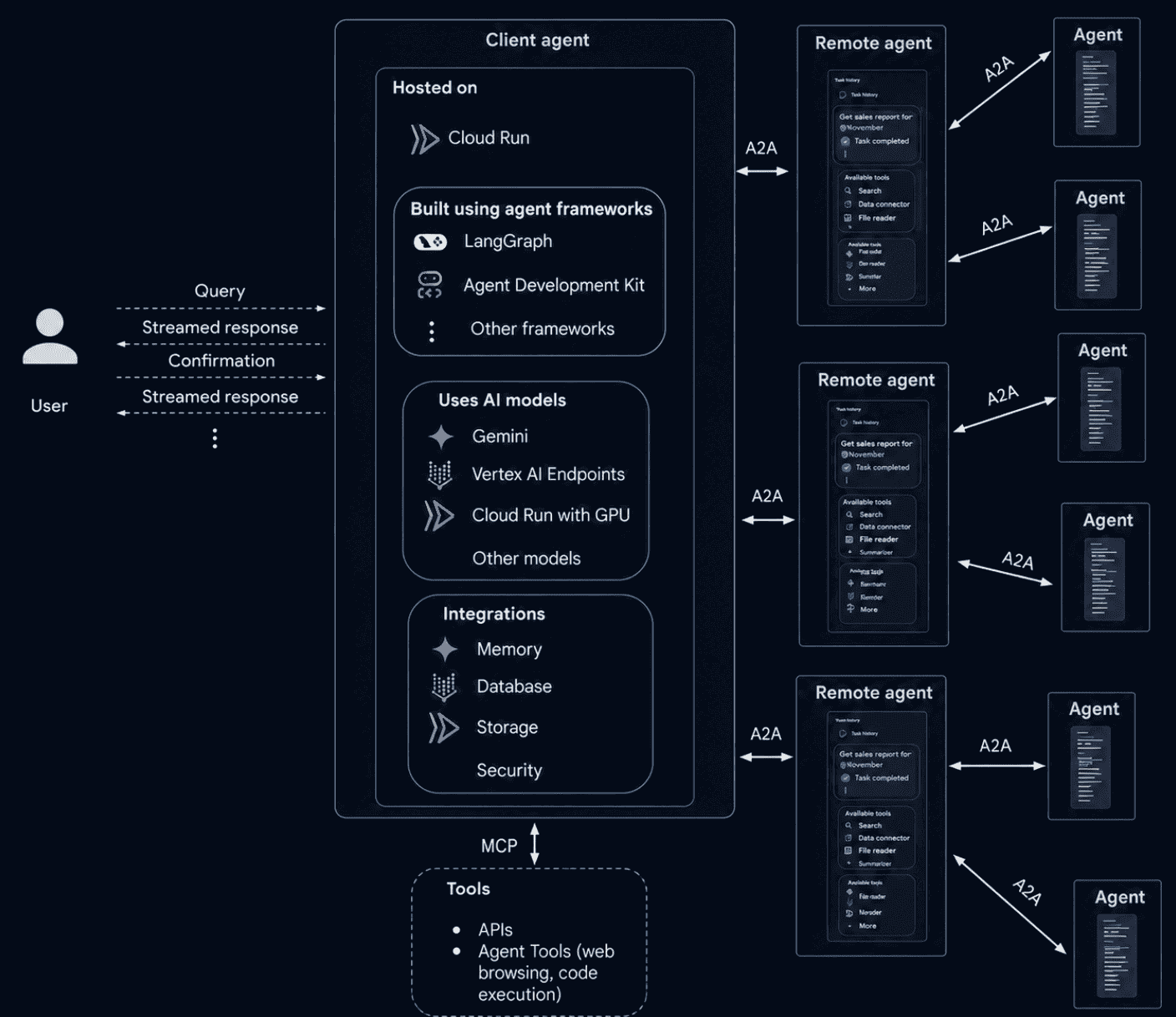
When looking at what the A2A protocol provides, it helps to understand the two roles it defines:
- Client agent: The one asking for help
- Remote agent: The one doing the work
This setup is flexible. Depending on the workflow, any agent can switch between a client and a remote server. This makes it easy for different tools to collaborate and solve complex problems together.
A2A protocol architecture: Core components
The A2A protocol uses four main building blocks to keep systems interoperable. These components define a consistent communication model that operates over HTTP and can also integrate into broader architectures that use message brokers like RabbitMQ or Apache Kafka. However, maintaining context depends on implementation details.
Agent cards
An agent card is a digital ID that describes the agent’s capabilities, what tasks it can handle, and the authentication it needs. In a production system, these cards help with discovery. If a card is missing or formatted incorrectly, the integration fails because the system can’t confirm the agent’s capabilities or permissions.
Tasks
Tasks are the specific units of work that agents can perform. Each task describes the payload, the expected output, and any quotas or limits. This is how a client agent tells a remote agent exactly what it needs.
If these aren’t clearly defined, the workflow can trigger an error requiring manual intervention because the executor won’t know which business process to run. Using a common language for tasks ensures reliable asynchronous communication, even across different software applications.
Messages and parts
Messages carry the actual data packets exchanged between tools, usually formatted as JSON messages. A single message is broken down into parts, which might include the core instructions and the metadata needed for context.
The server can’t exchange information when a message is malformed because it leads to data consistency issues. In this case, the agents are technically “talking” but don’t understand each other. For high-stakes B2B or supply chain systems, this could stop a batch processing job in its tracks.
Transport and streaming
This layer is the “road” the data travels on. It supports different ways of moving information from simple HTTP to optional message brokers. For real-time updates, it uses SSE to keep the connection open for data to flow without starting a new request each time.
If the transport layer isn’t set up right, your system will be slow or drop connections. A solid protocol ensures seamless agent communication, even when tools are busy with long running tasks. This keeps microservices fast and facilitates easy architecture scaling as your business and workflows grow.
How the A2A protocol works
The A2A protocol follows a structured sequence to make tools collaborate. It works much like a standard client-server model, where one agent makes a request and another fulfills it.
Discovery
Before two agents can collaborate, they have to find each other. In discovery, the client agent looks for a remote agent that has the right capabilities for the job. It does this by checking agent cards, which list the tasks a specific tool can handle.
If discovery fails, the workflow can’t progress. A solid discovery phase ensures your automation finds the best tool for the job without manual routing.
Authentication
Once the agents find each other, they need to prove who they are. Authentication uses standardized security like OAuth, mTLS, or JWT to make sure the connection is secure. The protocol checks authorization levels to see if the agent is allowed to delegate tasks or access specific data.
In a production environment, this is where you prevent unauthorized access. If the authentication is missing or wrong, the remote agent will reject the request. Using these enterprise-grade patterns ensures your agent communications stay secure and compliant.
Communication
The actual work begins after finishing this initial handshake. The agents now start to exchange structured data to complete the task. This asynchronous communication lets the client send instructions and then wait for a trigger or a callback once the output is ready.
By using the A2A protocol, the tools can interact and share context until they complete their goals. If there’s an error, the protocol provides clear reporting so the system can recover without halting the entire workflow.
A2A vs. MCP: Protocol selection for multi-agent architectures
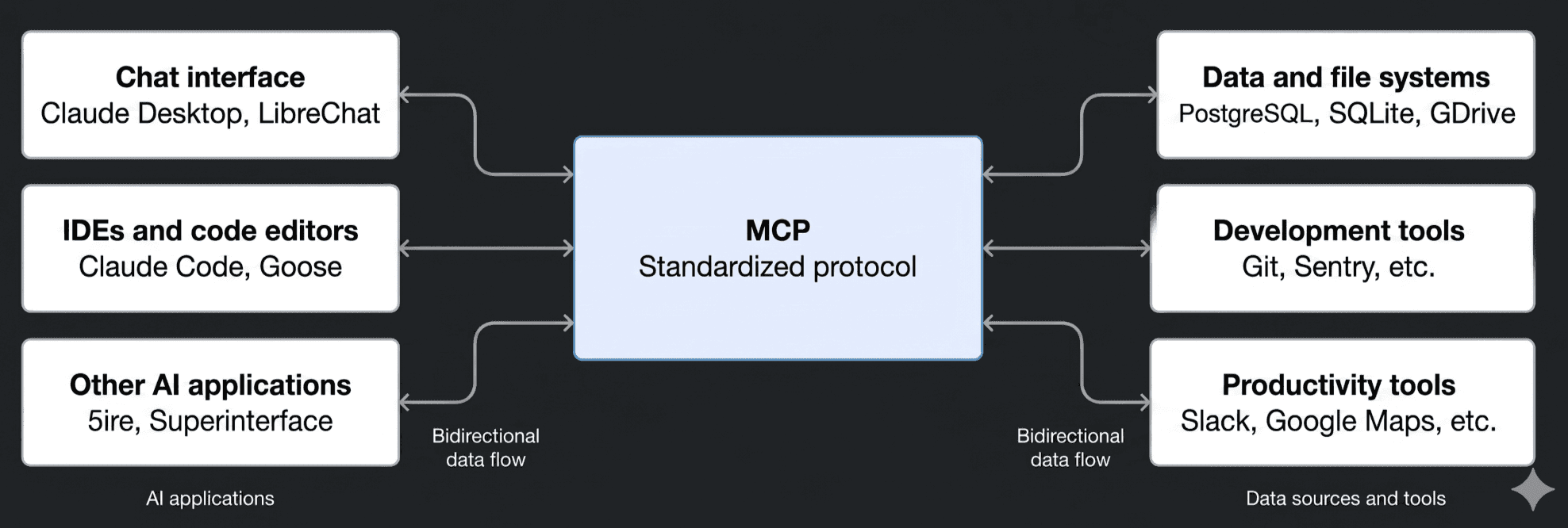
The A2A protocol and model context protocol (MCP) are complementary tools. MCP is a protocol that connects tools and services to a single agent. On the other hand, the A2A protocol acts as the middleware that lets those autonomous agents work together across different networks.
While the MCP server handles the connection between a client and its resources, A2A handles the interoperability between the agents themselves. The table below shows how MCP and A2A differ.
A2A security and authentication
The A2A protocol is built for large corporations that need to keep their data safe. It uses high-level security like mTLS to encrypt connections and OIDC authentication to check who’s logging in. Instead of using simple API keys, it relies on JWT and OAuth to make sure only the right agents have access.
This is important when deployed in production environments because it follows the same role-based access control (RBAC) rules your team already uses. AI systems can then use these security standards to delegate tasks without creating new security gaps for your business.
A2A implementation challenges
Moving to the A2A protocol makes systems more powerful, but it also adds new technical hurdles:
- Complex troubleshooting: Finding the source of an error is much harder when agents work asynchronously rather than in a simple setup.
- Security risks: Giving an agent the power to delegate tasks means you must be mindful about authorization to prevent data leaks.
- Context loss: If a message is missing critical details, the remote agent might not understand the goal, which can lead to a broken workflow.
- Network lag: High-traffic agent communication can slow down systems if message brokers aren’t configured for speed.
These challenges require a solid plan for observability and fine-tuning to keep production environments running smoothly.
Build the future of AI with A2A
Moving to the A2A protocol means making your system more independent while using stronger security. Teams must focus on clear discovery and authorization to ensure workflows run smoothly.
n8n provides the orchestration layer that keeps distributed systems manageable. Its agent features run on LangChain, giving you a structured way to expose sub-workflows as callable tools and to route tasks through different models or external services.
n8n integrates with frameworks like MCP and vector databases and can serve as the coordination hub for agents built on different stacks. And for teams experimenting with A2A today, the community has published an A2A node that brings protocol-level communication into n8n workflows.