
Large language models (LLMs) often struggle to give direct answers when prompted to complete complex, multi-step reasoning. Chain-of-thought (CoT) prompting addresses this limitation. It makes logic more transparent, helping teams debug incorrect outputs and verify the validity of the model’s conclusions.
Explore chain-of-thought prompting techniques and ways to implement them in your workflows.
What’s chain-of-thought prompting?
CoT prompting elicits a sequence of intermediate reasoning steps that the model used to arrive at its response. It aims to reduce clipped and inaccurate answers from LLMs.
LLMs are designed to provide responses, most of the time.
When complex queries lack high-quality answers, there’s a greater likelihood of AI hallucinations.
CoT simulates human logic by reducing complex problems to manageable parts, which improves the accuracy of responses. In fact, a study published by Frontiers Media SA showed CoT had the lowest rate of hallucinations compared to other prompting methods: 18.1% for CoT versus 34.5% for zero shot.
Here’s an example of chain-of-thought prompting versus standard techniques to illustrate the difference:
| Standard prompting | CoT prompting | |
| Prompt | A store has 34 loaves of bread. They sell 10 in the morning, receive a delivery of 12 more in the afternoon, and sell 8 more before closing. How many loaves of bread are left? | A store has 34 loaves of bread. They sell 10 in the morning, receive a delivery of 12 more in the afternoon, and sell 8 more before closing. How many loaves of bread are left? Think through this step by step and show your work. |
| Output | 28 loaves of bread. | Start with 34 loaves of bread. After selling 10 in the morning: 34 − 10 = 24. After the delivery of 12: 24 + 12 = 36. After selling 8 before closing: 36 − 8 = 28. So there are 28 loaves of bread left. |
| What happened | The model produced an immediate result with no transparency into how it arrived at an answer. | The model explicitly worked through each step in order to show how it arrived at the final answer. |
CoT prompting is one of the main mechanisms behind ReAct agents. In this agentic AI pattern, LLMs alternate between reasoning, taking specific actions, and observing results from external tools or databases.
CoT prompting techniques
While CoT is itself a technique for querying a reasoning model, it has several variations. The strategy you use depends on the query type and specific use case. Keep in mind that some generative AI models already have a built-in chain of thought, such as Google’s Gemini , and latest Anthropic Claude and OpenAI’s models. .
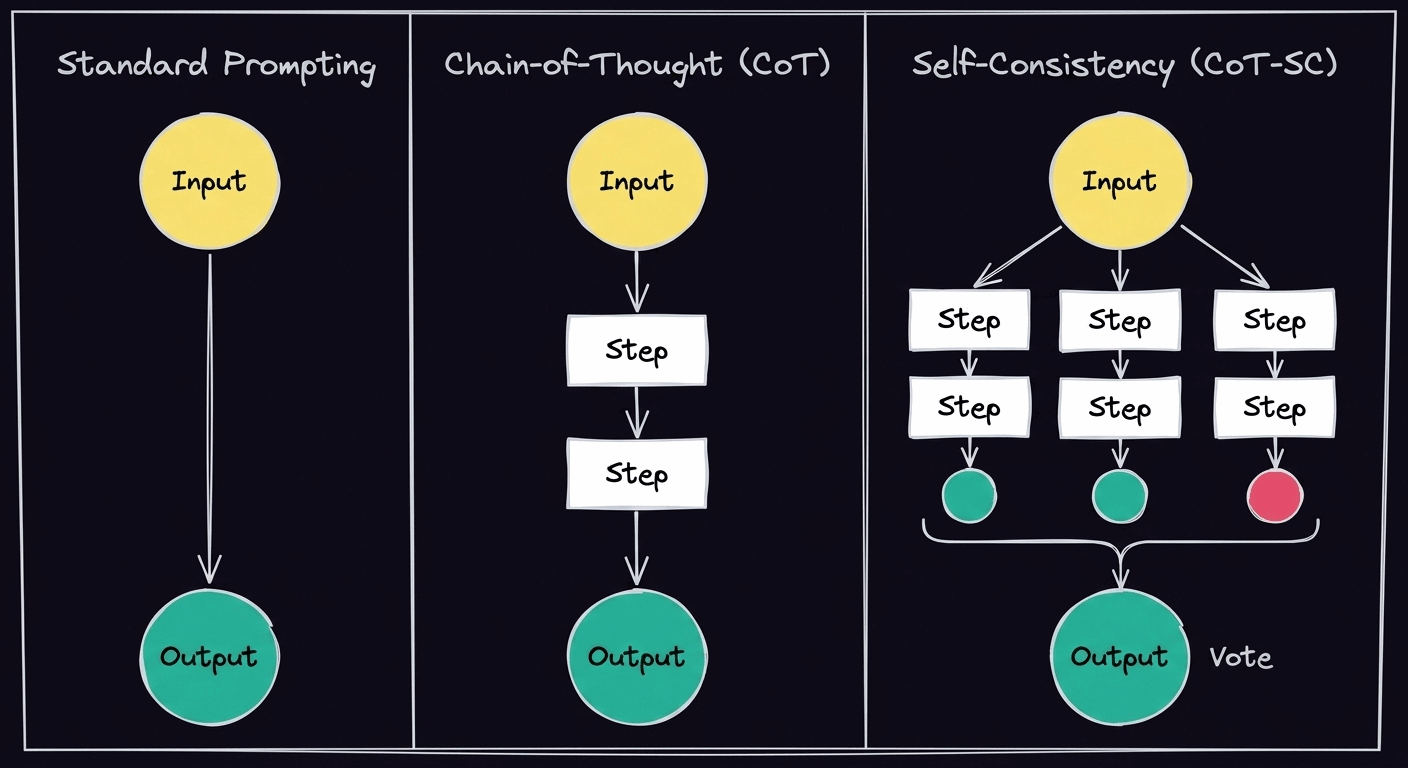
Here’s a comparison of the most common techniques.
Zero-shot CoT
Tech teams use this variant to trigger reasoning without providing specific examples. Instead, they add simple instructions like “think step-by-step” to the prompt, like the sample in the section above. Zero-shot CoT uses direct commands to capitalize on the inherent reasoning capabilities of LLMs.
Use case example: Developers use this to generate explanations for complex debugging tasks or algorithmic logic.
Few-shot COT
Few-shot prompting provides the model with three to five high-quality examples, including questions and the ideal answers, fully worked out with intermediate reasoning steps. The AI model learns the reasoning pattern in these examples and then mimics them when attempting to solve related problems.
Use case example: Business analysts can use this for complex reasoning tasks, such as calculating break-even points or optimal production levels after a significant price increase.
CoT with self-consistency
This approach generates multiple reasoning paths for the same problem and chooses the final answer through a majority vote. It works by mitigating one-off errors and averaging out individual logical missteps across five to 20 samples.
Use case example: Medical triage systems can use this to ensure diagnostic recommendations are consistent across various internal “thought” processes.
Step-back prompting
This technique instructs the system to abstract high-level principles or conceptual facts before it attempts to tackle the specific task. It broadens the model’s logic by prioritizing the big picture before jumping into the details and raw data.
Use case example: Marketing teams may use this to define industry-wide value propositions before identifying specific strategies to reach their target market.
Thread-of-thought (ThoT) prompting
ThoT prompting uses a specific inducer like “walk me through this context in manageable parts” to keep a coherent line of logic across a large context. It guides the model to analyze information through sequential chains of thought, which helps debug reasoning failures in long dialogues.
Use case example: Technical support agents can use this to manage troubleshooting sessions that span 10 or more conversational turns.
Implementing chain of thought in n8n
Using CoT differs based on the specific products you use to build and manage your AI agents. Coded implementations make sense if you need full control over cost and latency.
n8n lets teams design various prompting techniques on a visual canvas. Even highly technical teams can iterate and test different approaches with transparency. All steps are visible and not buried inside the code.
Manage CoT variations with Data Tables for prompt versioning and conditional branching for sub-workflows to select technique. Teams can manage these variations — like zero-shot, few-shot, and self-consistency — via native workflow primitives without messing with application code.
Start with deterministic Basic LLM Chain nodes for predictable results, then grow into Agent nodes. Agents use external tools to verify their reasoning against real-world databases. Execution history makes these chains fully inspectable.
This setup is fully auditable, leaving a clear, traceable log. Each execution leaves a record of the full prompt/completion pair at every node, letting admins inspect the model’s reasoning chain.
Teams can open the logs to see exactly where a model stumbled during its internal processing. This provides instant, detailed visibility and provides auditability for each run. Test CoT against standard prompts with n8n’s evaluations to monitor the reliability, tone, and accuracy of each output.
Chain-of-thought reasoning: When it works and when it doesn't
Using CoT reasoning won’t make sense for every query, and you shouldn’t force it into every workflow. It’s best for truly complex tasks that benefit from iterating through multiple steps before arriving at an answer. Look for instances where intermediate steps catch mistakes that a direct answer would miss. Here are a few common criteria:
- Arithmetic
- Symbolic logic
- Code generation
- Cumulative steps
Using step-by-step CoT instructions for simple tasks could hurt performance and reduce the quality of the output. For example, factual lookups require fast answers and rarely require multiple steps. Say a user asks a chatbot which holidays employees have off this year. Asking for step-by-step reasoning could create an unnecessary strain on processing. It might also encourage the model to second-guess itself and hallucinate, when its immediate answer would have been correct.
Deploy smarter reasoning workflows
Choose your prompt to fit the task’s complexity and accuracy needs. Simple automation goals don’t need elaborate logic, but production systems often demand the reliability of few-shot CoT.
While LLM chain of thoughts create focused, accurate answers, there’s more to it than just prompts. The tool you choose can make or break the reliability of your system and determine the ease of the build.
n8n’s AI agents, conditional branching, and execution history make it easy to design CoT-enhanced workflows. Manage dynamic executions through modular templates and a simple node-based canvas. You can run evaluations when needed, and n8n automatically logs every intermediate step for debugging and auditing, offering the visibility you need to iterate and improve after every run.