



AI agent hallucinations are hard to catch because they usually look like normal answers. An agent can invent a fact, misread retrieved context, or contradict itself without signaling that anything went wrong. Once that output triggers another workflow step, the mistake can quickly become a production problem.
Effective hallucination detection methods don’t rely on a single score. They need to be as multi-faceted as the hallucinations they catch. In this guide, we’ll break down how those methods work, where each one falls short, and how to layer them into AI workflows that are easier to inspect and control.
Types of AI hallucinations
Not all AI hallucinations fail in the same way. Models might invent a fact, drift away from the context they’ve been given, fill a knowledge gap with plausible-sounding details, or contradict something they said earlier.
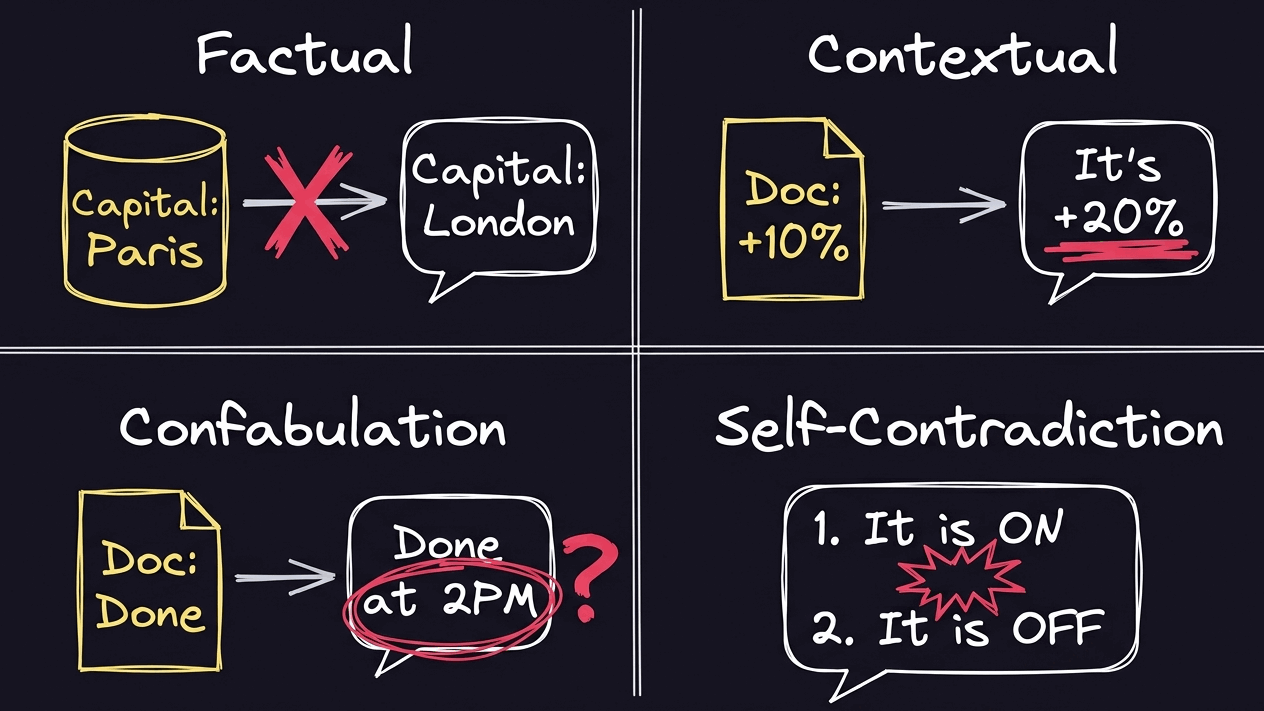
Knowing which failure you’re dealing with matters because each type calls for a different detection method. Here are the four main types of hallucinations to watch for:
- Factual hallucinations: The model makes a claim that conflicts with verifiable facts, like inventing a statistic, person, or event.
- Contextual hallucinations: The answer isn’t supported by the context supplied to the model. This is especially important in RAG systems, where an answer can sound reasonable while misrepresenting or going beyond the retrieved material.
- Confabulations: The model fills gaps with details that weren’t provided or established, producing a coherent answer without sufficient evidence.
- Self-contradictions: The model produces claims that conflict with other parts of its own response or with information it provided earlier.
These distinctions show why there’s no universal hallucination detector. A groundedness check can identify claims that stray from retrieved context, for example, but it won’t necessarily tell you whether the source material itself is factually correct. In production systems, reliable detection means matching the check to the failure mode — and often layering several checks together.
Detection methods that work in production
LLM hallucination detection works best as a layered system. No single check catches every failure mode: Some methods compare an answer with its context, others look for inconsistent outputs or uncertainty, and others escalate questionable results to a person. Combining these signals gives you more coverage than treating one score as a definitive pass or fail.
Faithfulness and groundedness checks
Faithfulness checks ask whether the model’s claims are actually supported by the context it received. For example, in a RAG workflow, you can break an answer into individual claims and compare each one with the retrieved documents, producing a score based on how much of the response can be traced back to that context.
Tools like DeepEval can automate this process, making faithfulness scoring useful for automated hallucination detection across test sets, evaluation datasets, and live outputs.
Self-consistency checks
With self-consistency checks, you ask the model the same question multiple times, then compare the answers. If independently generated responses converge on the same claims, you’ve got a useful consistency signal; if they disagree substantially, the output deserves more scrutiny. Because this method compares the model against its own outputs, it doesn’t require an external knowledge base.
The limitation is important, though: Different inference runs can converge on the same incorrect information. So think of consistency as a signal, not proof of accuracy.
Semantic entropy and uncertainty estimation
Semantic entropy looks beyond whether generated answers use the same words and asks whether they express the same underlying meaning. Generate several responses to the same prompt, group semantically equivalent answers, then estimate how probability is distributed across those meaning clusters.
High semantic entropy indicates that the model is uncertain about what the answer should be, making it useful for identifying outputs that need another validation step. Like self-consistency, however, uncertainty estimation tells you how stable an answer is, not whether it’s factually correct.
Source and retrieval verification
Faithfulness asks whether an answer reflects the context the model received; source verification asks whether its claims hold up against an authoritative external source. That distinction matters for a RAG hallucination caused by poor retrieval: A perfectly faithful answer can still be wrong if the retrieved document is outdated, irrelevant, or incorrect. Production workflows can verify important claims against authoritative repositories like databases, APIs, and documentation, making this approach especially useful when there’s a clear source of truth.
Confidence thresholds and human in the loop
Not every questionable output needs the same response. You can define confidence thresholds that route high-confidence results forward automatically, send ambiguous outputs through additional checks, and hold high-risk cases for a human in the loop before an agent takes an external action. The threshold should reflect the consequences of getting something wrong: An internal summary can tolerate more uncertainty than an agent preparing to modify a customer record or trigger a business process. This tiered approach lets teams keep humans in control where judgment matters without requiring manual approval for every execution.
Implementing detection with open-source tools
In practice, hallucination detection usually means combining an LLM evaluation framework with workflow logic that decides what happens when a check fails. A code-first framework like DeepEval can calculate metrics like faithfulness scoring, while guardrail libraries can add validation around model outputs.
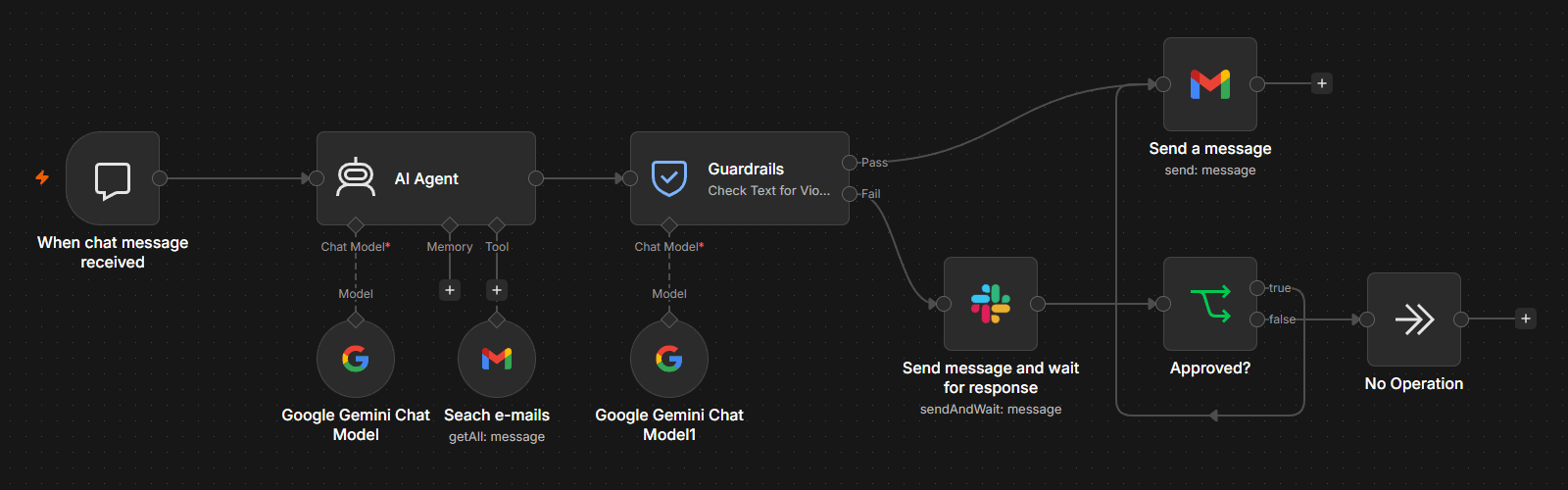
In n8n, a source-available AI-native automation platform, you can add checks around LLMs on the visual canvas and use the results to decide whether an output continues or gets retried or routed elsewhere. This keeps evaluation logic inside the same workflow that produced the answer instead of splitting detection across separate systems.
That workflow context also matters for AI agent observability. The AI Agent node keeps model and tool activity within an inspectable execution path, letting teams trace what the agent received and what it generated.
If a workflow fails, an Error Trigger node can start a separate error-handling workflow, while execution history lets you debug executions using the data from a previous run. The result is a layered setup: Evaluations and guardrails measure the model output, and workflow logic acts on the confidence score and routes the output to a corresponding branch. Finally, execution records give you the context to investigate failures.
Why detection alone isn’t enough
Hallucination detection reduces risk, but it can’t guarantee that every incorrect output gets caught. Scores depend on the quality of the context and evaluation method, thresholds can produce false positives or miss subtle errors, and even a well-grounded response can be wrong if its source is unreliable.
Detection works best alongside prevention, clear escalation paths, and LLM observability. When something does slip through, visibility into the model’s inputs, retrieved context, outputs, and downstream actions helps you trace the failure and improve the workflow instead of just flagging the results.
Building hallucination checks into production workflows
In production, each detection method covers a different failure mode, so the strongest workflows layer several checks:
- Faithfulness checks test whether claims match the supplied context.
- Source verification checks them against authoritative information.
- Consistency or uncertainty measures help identify answers that deserve more scrutiny.
- For higher-risk decisions, confidence thresholds can route an output to human review.
The important part is what happens after a problem is detected. In production, a flagged response needs somewhere to go: another validation step, a retry, an error workflow, or a person who can make the final call. Building those paths into the workflow makes hallucination detection part of how the AI system operates, not a test you run after something’s already gone wrong.
Put hallucination detection into practice with n8n
n8n gives you one place to orchestrate those safeguards alongside your AI agents to improve AI agent reliability. You can add custom evaluation logic, route flagged responses for approval, inspect execution data, and define what happens next when a check fails.
Ready to weave detection methods into production? Get started with n8n Cloud, or self-host the free Community Edition for full control over your AI workflows.
FAQ
How do I make sure my AI agent isn’t hallucinating?
You can’t completely prevent AI hallucinations, but you can catch more unreliable outputs by layering checks. Test responses for faithfulness, verify important claims against trusted sources, flag uncertain answers, and require human review when the risk of an incorrect action is high.
Do hallucination detection tools support multimodal outputs like images and audio?
Some do, but support depends on the detection tool and model. Multimodal evaluation can check outputs like images and audio, while text-only methods may require you to first extract a transcript or description.
Can hallucination detection block a bad answer before the user sees it?
Yes, run detection before the response reaches the user, then use a threshold to determine what happens next. A flagged output can be stopped, regenerated, sent through another validation check, or held for human approval instead of being returned automatically.