

There are three main ways people control the quality of AI systems: human-in-the-loop (HITL), human-on-the-loop (HOTL), and hybrid systems using both. These frameworks determine how systems make decisions and where humans intervene.
Each approach affects scalability, risk tolerance, and operational expenses. This oversight spectrum gives you a wide range of potential workflows depending on the task, whether your team needs tight human-driven control or occasional check-ins.
In this guide, learn the difference between human-in-the-loop versus human-on-the-loop. Plus, discover when to use each approach and how to implement it in your work.
What’s human-in-the-Loop (HITL)?
HITL is a process where AI performs tasks but humans control final decisions, preventing the system from executing certain actions without approval. This is a synchronous control pattern. The workflow stops at a decision gate until a human provides a required signal. For example, AI processes a loan application, deems it valid, then sends it to a human for final approval.
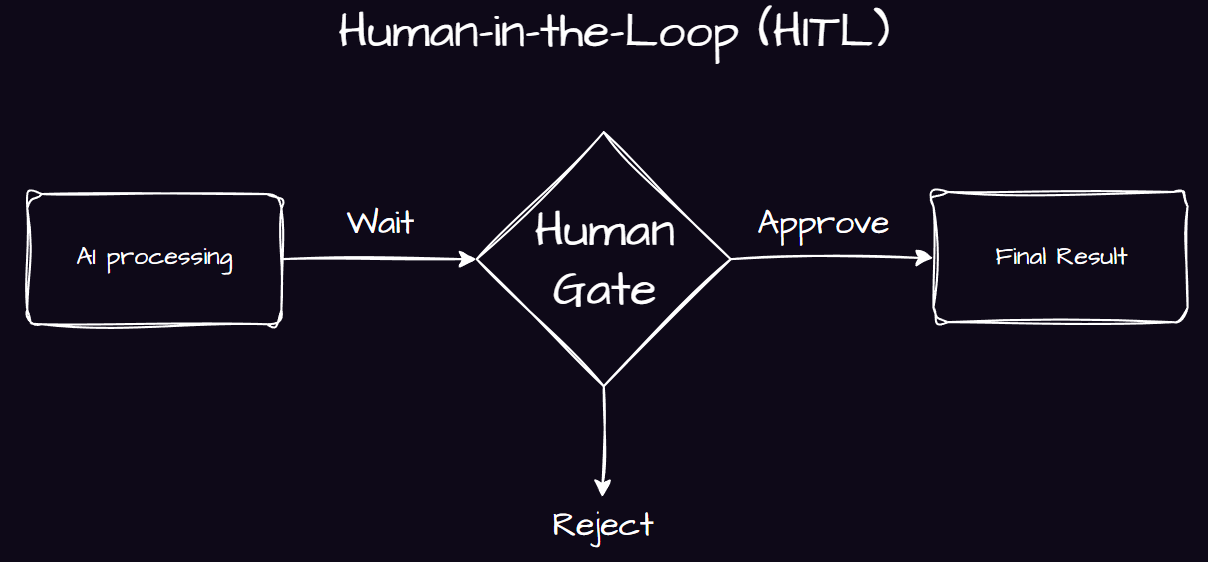
In an HITL pipeline, humans provide a manual touch in an otherwise automated workflow. For example:
- High-stakes actions: Humans approve critical actions, like confiming customers emails, social posts, or financial transactions, before AI sends them.
- Confidence uncertainty: The AI system measures uncertainty through confidence ratings. If confidence falls below a threshold, it calls in a human.
- Layered control: Some requests may need sign-offs by more than one person for security, so the AI halts progress until every stakeholder approves.
- Compliance oversight: Regulated industries like healthcare, finance and legal require human approval for certain decisions, regardless of AI confidence.
What’s human-on-the-loop (HOTL)?
HOTL is a process controlled by AI, but humans supervise or review the results. This loop is an asynchronous control pattern — fully autonomous and humans only handle exceptions and adjust parameters. For instance, AI processes customer orders autonomously, logging anomalies which humans review without interrupting the workflow.
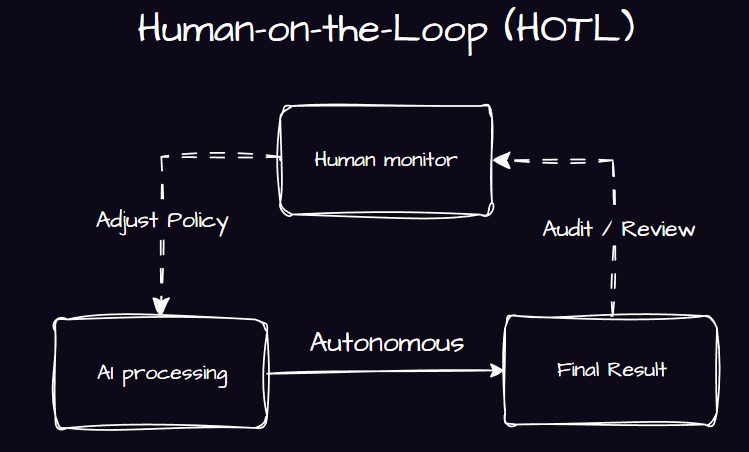
This process is primarily hands-off, and humans only intervene at the end of the workflow or if something goes wrong. Here are a few examples of HOTL workflows:
- Reviewing post-execution: Staff conduct a manual review of a random set of completed autonomous actions for quality control.
- Spotting anomalies: AI flags behavior that is out of the ordinary, usually to spot fraud or cyberattacks, but continues processes after flagging. Humans can conveniently review these flagged executions in time.
- Setting guardrails: Humans make changes to system controls at the level of governance, adjusting AI permissions rather than stopping the pipeline itself.
- Slowing and limiting processes: Staff set a confidence threshold, and when the uncertainty level rises high enough, the AI doesn’t execute and flags for review.
Human in-the-loop vs. human on-the-loop: Key differences
Both of these processes are useful — the choice is ultimately an architectural tradeoff that affects performance, risk, and accountability in AI agentic workflows. Here are the main differences:
AI systems typically evolve along this spectrum: New deployments start with tight HITL controls, then gradually shift toward HOTL monitoring as the AI proves reliable and teams gain confidence in automated decisions
When to use HITL vs. HOTL?
Choosing between HITL and HOTL in workflow-native platforms depends on how your system behaves under real-world conditions. Here are a few considerations:
In production, these approaches can coexist. A single workflow sometimes contains both: AI generates 1,000 product descriptions (HOTL monitoring), but requires human approval before publishing the top 50 to the homepage (HITL gate). This approach scales human attention to where it matters most. The platform you choose must support this hybrid setup.
HITL and HOTL use cases
Businesses use these structures in different workflows depending on risk, scale, and the areas where human judgment adds the most value. Here are a few HITL and HOTL agent applications.
HITL use cases
Let’s start with some common ways to use HITL:
- High-risk content moderation: AI systems can’t always detect human nuance and sentiment. Without human review, the program may block valuable content and permit harmful language, upsetting customers and adding legal risks.
- Autonomous vehicles: While AI sensors are getting better at operating vehicles, humans need to provide real-time intervention for compliance and safety.
- Legal contracts approval: Although AI can draft legal documents, experts still need to approve final versions before sending to clients or signing to ensure legal and ethical compliance.
HOTL use cases
Here are a few common applications for HOTL:
- Logistics and inventory: AI manages inventory and automatically issues supply orders. Humans monitor dashboards and only intervene in edge cases, like supply chain shortages or vendor strikes.
- Low-risk content moderation: LLMs monitor low-risk content, like comments and social media posts, posting acceptable cases and flagging anything that violates policies. Staff review flagged content to ensure it actually goes against rules.
- Financial transactions: AI systems monitor transactions and mark anything that seems suspicious. Humans review these alerts to decide whether to suspend accounts or investigate further, catching fraud and avoiding false positives.
Challenges in human oversight models
Implementing these architectures introduces operational and governance challenges. Here are a few obstacles to overcome:
- Queue saturation and latency: In HITL systems, manual reviews may become bottlenecks, requiring carefully configured confidence thresholds to avoid excessive human input.
- Automation complacency: Because AI is becoming increasingly reliable, human reviewers may trust outputs without scrutiny and miss necessary interventions in HOTL processes.
- Audit trail gaps: Both HITL and HOTL systems require strong logging and traceability — gaps create regulatory risk and make it impossible to diagnose failures.
- Inconsistent reviewer decisions: Without clear guidelines, different humans make different calls on similar cases. This produces unpredictable outcomes and undermines trust in the oversight process.
- Insufficient context for reviewers: Humans need full visibility into AI reasoning, input data, and confidence scores to make informed decisions — without it, approval becomes inefficient.
Addressing these challenges requires infrastructure that supports approval workflows, execution visibility, and audit logging — capabilities built into workflow automation platforms designed for production AI systems.
Implementing human oversight in n8n: HITL and HOTL workflows
AI often needs a human eye to perform successfully — that’s why n8n’s workflows allow humans to enter the picture at different stages. You can use HITL approval gates before an AI agent executes a specific tool or after AI-output and implement HOTL monitoring after the workflow runs.
For HOTL workflows, n8n’s systems can easily operate independently, logging every execution in workflow history and sending alerts via error workflows or notifications, notifying staff to take action when review is needed. This means your team stays informed without being a bottleneck.
For HITL workflows, n8n supports three core patterns:
- Inline chat approval: Use the Chat node's "Send and Wait for Response" operation to present AI outputs directly in a chat interface. Reviewers can approve, reject, or modify outputs before the workflow continues.
- Tool call approval gates: Add approval gates on AI Agent tools so that specific tool calls require human confirmation before they execute. This is ideal for high-risk actions like database writes or sending external communications.
- Multi-channel review workflows: Route approvals through Slack, Gmail, n8n Chat, or other channels your team already uses. Combine these with IF nodes to route only low-confidence outputs for approval.
Beyond these patterns, n8n offers several features that support human oversight:
- Role-based access control: On Business+ plans, only authorized users can modify workflows and make decisions.
- Audit logs: Track decisions made at each step for compliance and accountability
- "Send and Wait for Response" operation with timeouts. Set time limits on approval steps to prevent workflows from stalling indefinitely (docs)
- Error workflows: Automatically alert your team when something fails or needs attention
Optimize AI workflows with n8n
The HITL and HOTL systems create a complementary oversight spectrum, and they both have their uses. HITL gives control, holds your team accountable, and embeds human judgment in key decisions, while HOTL lets us work faster through high-volume tasks with post-execution review.
In real world situations, using a mix of HITL and HOTL in the same workflow provides the right balance between managing risk, efficiency, and compliance.